
Skip to content
Transportation

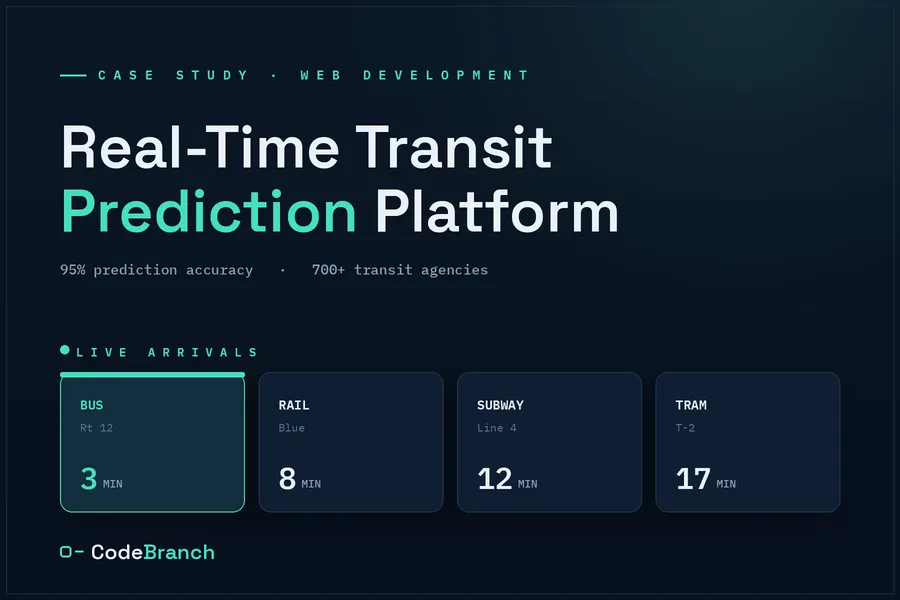
Real-Time Transit Prediction Platform

Predicting transit arrivals to the second — from unreliable legacy to 95% accuracy across 700+ agencies.

Quick Summary

  • CodeBranch rebuilt the prediction engine behind live arrival boards at bus stops and train stations across the U.S., achieving 95% accuracy and automating data ingestion from 700+ transit agencies.
  • 95% prediction accuracy — up from a baseline too unreliable to measure
  • 700+ transit agencies feeding live arrival data into the platform
Tech Stack: PHP Google Cloud Platform
Real-time transit prediction platform — CodeBranch

Overview

A real-time transit platform powers the live arrival boards at bus stops, train platforms, and transit stations across the U.S. The system feeds the countdown displays that tell passengers when the next service is arriving — and the accuracy of every screen depends on how well the backend predicts what's actually coming. CodeBranch rebuilt the prediction engine and automated the data pipeline in two consecutive projects. The first delivered a new algorithm that predicts arrivals down to the second across buses, trains, subways, trams, and cable transit. The second eliminated the manual data ingestion process, replacing a daily "publish" ritual with automated validation and self-protecting data flows across 700+ independent agency databases. The entire engagement was delivered by a single CodeBranch engineer acting as architect, developer, tester, and project manager — the kind of lean, accountable ownership that turns a year-long rebuild into something a client can trust at scale.

Industries

Transportation

Services Provided

  • Web Development
  • Custom Software Development

Approach

CodeBranch took a two-phase approach, each as a standalone project. The engineer owned architecture, build, testing, and delivery end-to-end. In the first project, the team designed a new prediction algorithm that calculates second-level arrival predictions across every transit mode — buses, trains, subways, trams, and cable transit. The legacy model was kept running in parallel so agencies could compare old vs. new predictions before committing to the switch. Roughly 400 of 700+ agencies have migrated so far, with the client reporting 95% accuracy against a target of 100%. In the second project, the focus shifted to the data pipeline. The manual "publish" step — where a team member clicked to push each agency's data update into the system — was replaced with automated ingestion. Each incoming feed is validated against upcoming stops at a reference station, rejecting stale or future-dated data instead of publishing it. When a feed reports a week ahead, a Discord alert flags it for human review. The system is self-protecting: when in doubt, it keeps the prediction that's currently accurate rather than replacing it with unverified data.

1x Full-Stack Engineer (Architect, Developer, Tester, PM)

Results

  • 95% prediction accuracy — up from a baseline too unreliable to measure
  • 700+ transit agencies feeding live arrival data into the platform
  • Zero manual "publish" clicks — a daily ritual, now fully automated
  • Second-level arrival predictions for buses, trains, subways, trams, and cable transit
  • Automated validation rejects stale or future-dated data with Discord alerts for edge cases
  • Delivered end-to-end by a single CodeBranch engineer over ~12 months

Frequently Asked Questions

How can CodeBranch help build a real-time transit or transportation platform?
CodeBranch builds the backend systems that power real-time transit infrastructure — prediction algorithms, live data ingestion pipelines, and the server architecture that feeds physical display boards at stations. In this project, a single CodeBranch engineer rebuilt the entire prediction engine and automated data pipeline for a platform serving 700+ transit agencies across the U.S., handling buses, trains, subways, trams, and cable transit. CodeBranch works as a nearshore partner from Medellín, Colombia, in overlapping U.S. time zones.
What kind of prediction accuracy can CodeBranch achieve for transit arrival systems?
In this engagement, CodeBranch designed a new prediction algorithm that brought accuracy from a baseline too unreliable to measure to 95% client-reported accuracy, with 100% as the standing goal. The algorithm predicts arrivals down to the second across every transit mode — not just buses, but also trains, subways, trams, and cable transit. The legacy model ran in parallel during migration so agencies could compare results before committing.
Can CodeBranch automate data ingestion from hundreds of independent sources?
Yes. In this project, CodeBranch automated the ingestion of live timing data from roughly 700 independent transit agency databases. The previous process required a team member to manually click "publish" for each update. The automated pipeline validates each incoming feed against upcoming stops at a reference station, rejects stale or future-dated data, and sends Discord alerts for edge cases that need human review. The system is self-protecting — when in doubt, it keeps the currently accurate prediction rather than replacing it with unverified data.
How does CodeBranch handle complex backend projects with a lean team?
CodeBranch delivered this entire engagement — two consecutive projects spanning approximately 12 months — with a single engineer who acted as architect, developer, tester, and project manager. This lean, accountable ownership model means the person who designs the architecture is the same person who builds it, tests it, and delivers it. For complex backend problems like prediction engines and multi-source data pipelines, this eliminates handoff delays and ensures deep technical continuity throughout the project.
What technologies does CodeBranch use for real-time data platforms?
This transit prediction platform was built with PHP across multiple backend services, hosted on Google Cloud infrastructure managed by the client. CodeBranch adapts to the client existing tech stack rather than forcing a rewrite — the goal is to solve the engineering problem, not to introduce unnecessary technology changes. For real-time data projects, CodeBranch has experience with PHP, Python, Node.js, and cloud platforms including Google Cloud, AWS, and Azure.

Related Case Studies

Ready to Build Something Great?

Let's discuss your project and find the perfect solution for your business.