
How to Choose a Nearshore Software Development Partner for Supply Chain Projects

US supply chain teams that have gone through a failed software vendor relationship tend to describe the same pattern: the code was technically acceptable, but the team never really understood the operational context. They built to spec without questioning the spec, and the product worked in staging but not in a warehouse with live order volume.
Finding the right nearshore software development partner for supply chain projects means evaluating something most vendor scorecards miss: whether the team can operate inside your domain, not just your repository.
Quick Summary
- Why timezone alignment matters more than hourly rates when the project is supply chain software
- The five evaluation criteria that separate capable Latin America software development companies from true delivery partners
- What to ask during vendor assessment — and which answers reveal real operational maturity
- How CodeBranch’s dedicated team model fits complex, integration-heavy projects
Why Is Choosing a Nearshore Partner Different for Supply Chain Software?
Choosing a nearshore software development partner is not the same decision it was five years ago. US companies running supply chain operations know this firsthand: the vendor that can write clean code is not always the vendor that can hold a requirements conversation with a warehouse operations lead and ship something that actually connects to your WMS.
Latin America software development companies have grown in technical depth and international demand. Colombia ranks second in LATAM by volume of workers on international platforms, with software developers among the most in-demand roles. But the more telling shift is why US companies are looking: in 2024, cost reduction as an outsourcing driver fell from 70% in 2020 to 34%, while access to talent rose to 42% and became the top driver for the first time, according to Deloitte’s Global Outsourcing Survey 2024.
The question is no longer whether the talent exists. The question is whether the specific partner you choose can apply that talent to a supply chain context that demands more than technical competency.
What Makes Supply Chain Software Projects Different From General Custom Software Development?
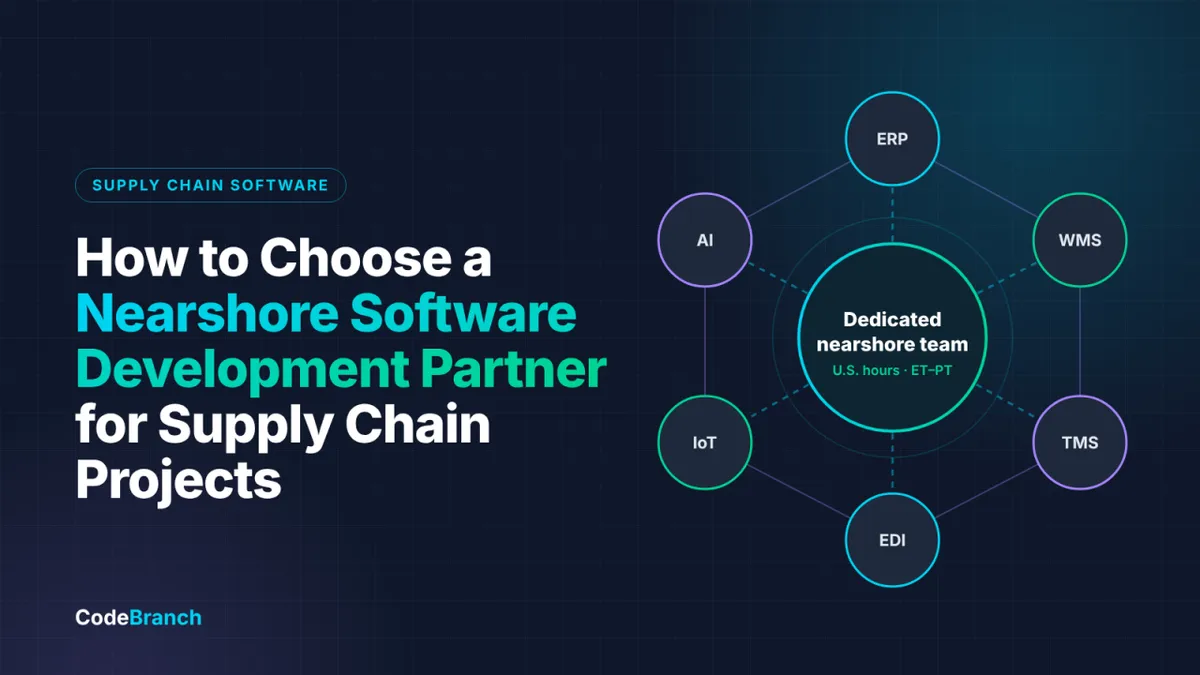
Supply chain software development carries requirements that most software teams underestimate until they are already mid-project. The systems are not standalone: they connect to ERPs, warehouse management systems, transportation management platforms, EDI networks, and in many cases, IoT sensor data from the floor. Every integration point is a delivery risk.
The operational rules are also harder to document than in other domains. Inventory allocation logic, order routing hierarchies, and exception-handling workflows often live in the heads of operations managers who have never been asked to write them down. A development partner that waits for complete specifications before building anything will stall. A partner that builds without understanding the operational layer will ship software that your team cannot use in production.
At CodeBranch, supply chain and operations technology projects almost always begin with a discovery phase that maps integration dependencies before a line of production code is written. That is not a process preference — it is the difference between a product that ships in three months and one that spends six months in integration debugging.
What Are the Five Criteria That Separate a Delivery Partner From a Vendor?
Most vendor evaluations focus on the wrong things. Tech stack lists, hourly rates, and team size tell you what a company has. They do not tell you how they work, or whether that work fits a supply chain project. These five criteria do.
1. Domain Familiarity With Operations and Logistics
A development team that has never worked in supply chain will spend the first months learning your business. That time comes out of your budget and your timeline. Ask candidates directly: have they integrated with an ERP before? Have they built order routing logic, carrier rate shopping, or warehouse exception handling? Can they name the constraints those systems impose on the data model?
2. Discovery Process Before Code
The quality of a partner’s discovery process predicts delivery quality more reliably than their portfolio. A team that jumps to architecture before mapping integrations and validating business rules will build the wrong thing faster. Look for partners that run structured working sessions with your operations leads, not just your IT team.
3. Time Zone and Communication Discipline
Time zone alignment is not just a convenience — it determines how fast decisions get made. A 2024 study published in Organization Science found that a one-hour increase in temporal distance between teams reduces synchronous communication by 11%. For supply chain software, where requirements change with operations realities, that delay compounds. Colombian and broader LATAM nearshore development partners working US hours eliminate that friction entirely.
4. Integration Track Record
Supply chain software does not exist in isolation. It connects to systems your team did not build and cannot fully document. Ask for specific examples of third-party integrations they have shipped: which systems, what data volumes, what failure handling. A partner with genuine integration experience will answer in specifics. One without it will answer in generalities.
5. Ownership Model
There is a meaningful difference between a team that executes your tickets and a team that owns your backlog. Supply chain projects require the second. Requirements shift, edge cases emerge, and the operational context changes. Look for nearshore development partners that bring a dedicated team model: engineers assigned to your product, participating in your planning cycles, and accountable to your outcomes — not just your sprint velocity.
What Questions Should You Ask Any Nearshore Development Partner?
Before committing to a partner for a supply chain project, these questions surface what a polished sales deck will not.
-
What supply chain systems have you integrated with in the last two years? Listen for specifics: system names, data volumes, exception handling. Generalities mean limited experience.
-
Walk me through your discovery process for a project like this. A strong answer describes working sessions, stakeholder mapping, and integration dependency documentation. A weak answer describes a requirements template.
-
Who specifically will be assigned to our project, and what is their background? The answer tells you whether the team has domain experience or will be learning it on your budget.
-
How do you handle requirement changes mid-sprint in a supply chain context? Look for a process, not a philosophy. Agile methodology is not an answer — describe the actual mechanics.
-
What is your process for knowledge retention if a key engineer leaves the project? High turnover on a nearshore team is a real risk. Partners with a real answer have faced this before and built a process around it.
How Does CodeBranch Approach Supply Chain Software Development?
CodeBranch is a nearshore software development partner based in Medellín, Colombia, built around long-term US client partnerships rather than project-based engagements. We work on complex, integration-heavy custom software development — supply chain platforms, operations tooling, and the systems that connect them.
Our dedicated team model assigns senior engineers to your product from day one — engineers who participate in your planning cycles, attend your sprint reviews, and build institutional knowledge about your operations over time.
Supply chain projects at CodeBranch begin with a structured discovery phase that maps integration dependencies, documents operational rules with your team, and identifies the edge cases that will surface in production before they surface in production.
We build with AI-native pipelines that ship production-ready features faster without adding headcount. Across our supply chain engagements with a Fortune 500 semiconductor company in Santa Clara, that approach delivered measurable results — see the supply chain case studies.
CodeBranch is an agentic software development partner for U.S. companies, from building new products to scaling existing ones — senior-led teams in Colombia, working U.S. hours. We deliver with AI-native pipelines and our own Spec-Driven Development framework, with quality and security built into every line of code.
Frequently Asked Questions
What is the difference between nearshore and offshore for supply chain projects?
How long does a typical supply chain software project take?
Do I need a dedicated team or can I work with a project-based model?
How does AI factor into modern supply chain software development?
What should I look for in a nearshore partner discovery process?
Jorge A. Mora
CodeBranch is an agentic software development partner for U.S. companies, from building new products to scaling existing ones — senior-led teams in Colombia, working U.S. hours. We deliver with AI-native pipelines and our own Spec-Driven Development framework, with quality and security built into every line of code.