
HealthTech Platforms Building the Infrastructure of Modern Healthcare
CodeBranch Team
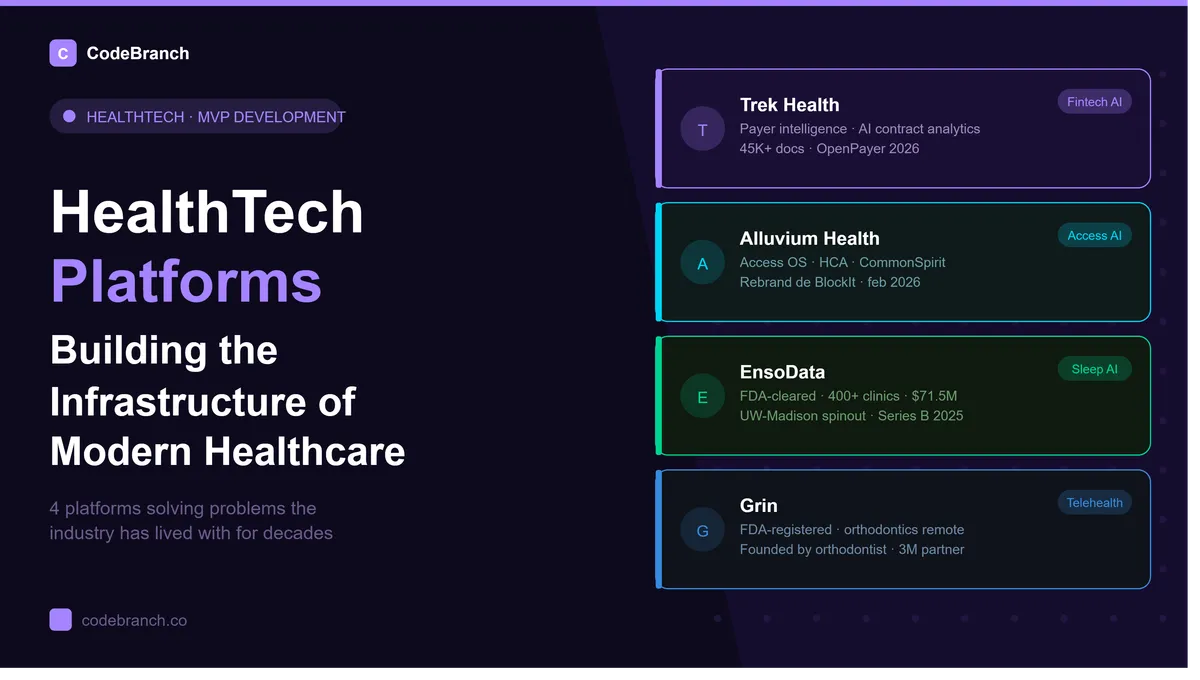
Most healthcare technology coverage focuses on the same handful of enterprise names. What gets less attention are the companies building the infrastructure layer underneath — the platforms that make it possible for providers, payers, and patients to actually interact with each other efficiently.
These four companies are doing exactly that. None of them are household names outside of their sectors. All of them are solving problems that the healthcare system has lived with for decades.
Trek Health — Closing the Information Gap Between Providers and Payers
Provider organizations have negotiated payer contracts at an information disadvantage for decades. Payers have detailed data on reimbursement rates across the market. Providers have had their own contracts and whatever they could piece together from public sources.
Price transparency regulations — which required payers to publish machine-readable rate files — changed what data is theoretically available. The problem is what it takes to turn that data into something usable.
Trek Health’s Price Transparency Platform addresses exactly that. What they’ve built:
- Standardized more than 45,000 policy documents from over 100 commercial payers into a structured, queryable intelligence layer
- Each document indexed by billing codes, reimbursement methodologies, negotiated rate implications, and service lines
- OpenPayer, launched in February 2026, added real-time policy monitoring — flagging reimbursement risks before they affect financial performance
Three months after launching OpenPayer, Trek Health passed 10,000 monthly active users — a signal that the market for this kind of contract intelligence was more developed than most expected.
The engineering challenge here is the data itself: payer machine-readable files are large, inconsistently formatted, and structured around payer conventions rather than provider workflows. Turning them into actionable negotiation intelligence is a data pipeline and engineering problem at scale.
Alluvium Health — An Operating System for Health System Access
Scheduling inside a large health system is not a booking problem. It’s a capacity problem — and most health systems are still solving it with fragmented point solutions, phone calls, and faxes.
BlockIt, a leader in enterprise access and capacity performance, rebranded as Alluvium Health in February 2026 — a signal of how significantly the company’s scope had expanded beyond its origins as a scheduling tool. Alongside the rebrand, Alluvium launched Orchestrate, an AI-powered operational data insights platform built specifically for network access and capacity management.
The problem Alluvium addresses:
- Health systems that have grown through mergers and acquisitions end up with multiple EMR environments, disparate scheduling workflows, and no unified view of supply and demand across the network
- The result is access fragmentation — patients routed incorrectly, providers underutilized, and referral leakage that’s invisible until it shows up in the revenue report
Alluvium’s platform treats access the way mature organizations treat revenue cycle: as a system with measurable inputs, outputs, and optimization levers. Clients include HCA, CommonSpirit, and Memorial Hermann — among the largest health systems in the United States.
EnsoData — From University Research to 400+ Clinics and FDA Clearance
Sleep apnea affects an estimated 54 million people in the United States. Around 80% of them are undiagnosed. The diagnostic bottleneck isn’t clinical — it’s logistical. Traditional sleep studies require specialized equipment, trained technicians to score the results manually, and lab infrastructure that most markets can’t sustain at the volume the problem requires.
EnsoData was founded in 2015 as a University of Wisconsin-Madison spinout to address exactly that bottleneck. The founding team combined clinical sleep expertise with machine learning to automate the most time-intensive part of the diagnostic workflow: waveform analysis and sleep study scoring.
What they’ve built over the past decade:
- EnsoSleep, their flagship platform, is FDA-cleared and deployed across more than 400 clinics, analyzing EEG and EKG signals to diagnose sleep apnea and other neurological conditions
- In February 2024, EnsoData received an additional FDA 510(k) clearance for EnsoSleep PPG — enabling AI-powered sleep diagnosis using standard pulse oximeters instead of traditional polysomnography equipment, dramatically lowering the access barrier
- In June 2025, the company raised a $20M Series B led by Questa Capital, bringing total funding to $71.5M, directed toward expanding the US commercial team
- To date, EnsoData has impacted the sleep care pathway for more than 2.5 million patients
The engineering angle here is one of the more interesting in healthcare AI: EnsoData maintains an open database of over one million sleep studies, available at no charge to researchers and medical device manufacturers. That data infrastructure is both a research contribution and a competitive moat — the model gets better as the dataset grows, and the dataset grows as more clinics deploy the platform.
Grin — The Orthodontist’s Office in a Smartphone Attachment
Orthodontic treatment has a compliance problem. Patients — especially adolescents — miss appointments, lose aligners, and go weeks without a clinician seeing what’s actually happening in their mouth. The standard response has been more frequent in-office visits, which creates scheduling pressure on practices and inconvenience for patients.
Grin was founded by Dr. Adam Schulhof, an orthodontist who beta-tested the platform in his own practice before taking it to market. The core product: a physical scope that attaches to any smartphone camera, paired with an app that guides patients through a self-scan of their mouth in under 60 seconds.
What makes it work clinically:
- The Grin Scope is an FDA-registered medical device that gives orthodontists intraoral visibility comparable to an in-office exam — not a consumer photo, a clinical scan
- Orthodontists review scans through a web portal, comment on treatment progress, and communicate with patients through the app — reducing chair time without reducing clinical oversight
- The platform connects to existing treatment workflows for both braces and clear aligner cases
Grin has partnered with 3M Oral Care Solutions as a nationwide distributor, and has since expanded through a collaboration with Oral-B — integrating brushing behavior data into the monitoring picture alongside treatment progress.
The broader implication for healthcare software is the model itself: Grin didn’t try to replace the orthodontist. It gave the orthodontist a tool that makes remote supervision clinically credible.
What These Four Companies Have in Common
They’re solving different problems in different parts of the healthcare system. But the pattern underneath is the same.
Each of them took a workflow that the industry had accepted as manual, fragmented, or inaccessible — payer contract intelligence, health system scheduling, sleep diagnostics, orthodontic monitoring — and rebuilt it as a software layer — often using microservices and APIs — that makes the underlying data usable in real time.
None of them replaced the clinicians, administrators, or specialists who were already doing the work. They gave those people better information, faster, with less friction.
For engineering teams building in healthcare software, these four companies represent four different versions of the same challenge: how do you build software that clinical users will actually trust and use, inside regulatory constraints that most software industries never have to think about?
The answer, in each case, involved the same things: starting with the clinical workflow rather than the technology, building compliance in from the start, and designing for the user who has no tolerance for tools that slow them down.
CodeBranch builds agentic software for product teams in the United States — including healthcare platforms where the compliance requirements and clinical adoption challenges described above are the starting point, not an afterthought.
Written by the CodeBranch team — Medellin, Colombia. CodeBranch specializes in agentic software development for healthcare companies. codebranch.co
Frequently Asked Questions
What are HealthTech infrastructure platforms?
Why is building healthcare software more complex than other enterprise software?
How does CodeBranch approach healthcare software development?
Can CodeBranch build software that integrates with existing EHR systems?
CodeBranch Team
CodeBranch is an agentic software development partner for U.S. companies, from building new products to scaling existing ones — senior-led teams in Colombia, working U.S. hours. We deliver with AI-native pipelines and our own Spec-Driven Development framework, with quality and security built into every line of code.