
Construction Software in 2026: What's Being Built, What's Complex, and What Generic Platforms Don't Solve
CodeBranch Team
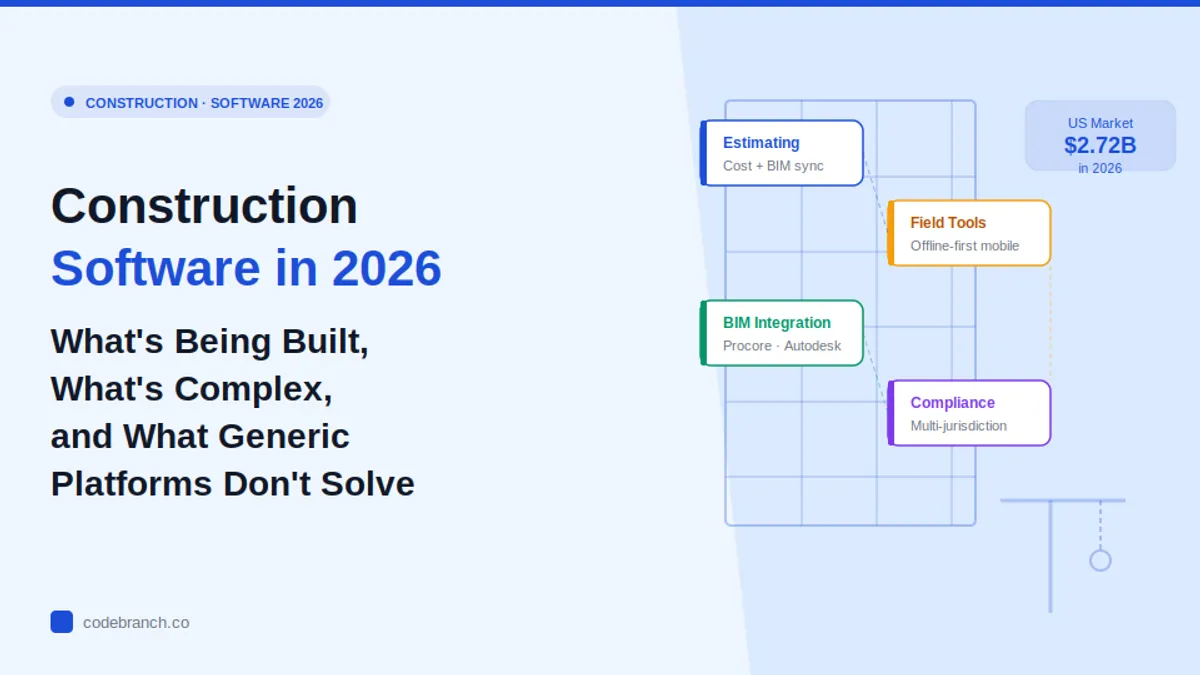
The US construction software market is projected to reach $2.72 billion in 2026, growing at nearly 10% annually — and the growth is happening in specific categories, not across the board. The companies driving that number are building platforms that solve problems the industry has lived with for decades: estimating that drifts from actual costs, field and office teams working from different information, and tools that don’t connect to the BIM or ERP systems already in use. Most of that software is custom-built. Not because the industry enjoys complexity, but because construction projects are complex in ways that generic platforms consistently underestimate.
Quick Summary
- Construction software investment in 2026 is concentrated in three categories: project management and estimating, BIM integration tools, and field reporting and mobile tools
- Construction software is technically harder than it looks — hostile user environments, non-standard data models, mandatory integrations, and jurisdiction-specific compliance all compound
- Off-the-shelf platforms fall short when estimating logic is proprietary, integration requirements are too specific, or field workflows are unusual
- CodeBranch approaches custom construction software with a Product Definition phase first, then an agentic development pipeline — delivering faster without sacrificing integration fidelity
What Construction Companies Are Actually Buying in 2026
Construction software investment is concentrated in three categories right now.
- Project management and estimating platforms account for the largest share — around 57% of demand comes from project management solutions, and the estimating software market alone is growing at 9.9% annually. (Source: Fortune Business Insights) The driver isn’t novelty — it’s that the cost of inaccurate estimates in a construction project is high and measurable. Every percentage point of cost overrun on a large project translates directly to margin.
- BIM integration tools are the second major growth area. Nearly 33% of market growth is driven by BIM integration tools — which reflects how central building information modeling has become to how projects are designed, coordinated, and handed off between trades. The problem is that most companies have a BIM platform and a project management platform that don’t talk to each other well. The software that closes that gap is being built, not bought off the shelf.
- Field reporting and mobile tools are the third. Construction crews work in conditions where office-based software consistently fails — intermittent connectivity, physical constraints, users who need information in 10 seconds or not at all. Owners now demand real-time cost and schedule visibility that connects design intent with field execution — and delivering that visibility requires mobile-first tools built for the job site, not adapted from office software. (Source: Mordor Intelligence)
What these three categories share is a resistance to generic solutions. The reasons are worth understanding before evaluating options.
What Makes Construction Software Technically Harder Than It Looks
Construction software has a set of constraints that most product teams underestimate before they start building.
- The user environment is hostile to standard assumptions. Software built for an office assumes reliable connectivity, a keyboard, and a user with time to navigate a multi-step interface. A field reporting tool used by a crew supervisor on a job site operates in none of those conditions. Offline-first architecture, GPS integration, camera access, and interfaces that work with work gloves on are not features — they are baseline requirements.
- The data model has to reflect how construction actually works. A generic platform models construction the way its product team imagined it — not the way a specific operation actually runs. A project can have multiple owners, dozens of subcontractors, hundreds of cost codes, and compliance requirements that vary by municipality. That variation doesn’t fit a standard schema.
- Integration with existing tools is non-negotiable. Construction companies don’t replace their entire tech stack when they adopt new software. A new estimating tool has to export to Sage or QuickBooks. A project management platform has to connect to Procore or Autodesk BIM 360. The integration work is where most construction software projects surface their real complexity — and it surfaces mid-build, not before.
- Compliance requirements vary by jurisdiction. Safety documentation, inspection checklists, reporting formats, and permit requirements differ by state, county, and municipality. A platform built for a contractor working in multiple states needs a data model flexible enough to handle the variation without requiring a developer for every new jurisdiction.
Where Off-the-Shelf Platforms Consistently Fall Short
Generic construction platforms — Procore, Autodesk, Buildertrend — are excellent products that solve the most common construction workflows well. The gap appears when a company’s operation doesn’t fit the assumptions those platforms were built around. Three situations consistently push construction companies toward custom software:
- When the estimating logic is proprietary. Unitary price analysis methods, supplier relationships, and cost structures specific to one company’s operation can’t be modeled in a generic estimating tool without significant workarounds. The workarounds accumulate until the platform becomes an obstacle rather than a tool.
- When the integration requirement is too specific. A contractor that needs to connect a custom quoting tool to a legacy ERP, or sync field data with a proprietary equipment management system, will find that generic platform APIs weren’t designed for that use case. The integration either doesn’t exist or requires a level of customization that costs more than building from scratch.
- When the field workflow is unusual. Companies that work in specialized construction categories — electrical infrastructure, IoT-connected buildings, industrial facilities — often have field workflows that no generic mobile app handles correctly. The result is crews using workarounds that create data quality problems in the back office.
CodeBranch has built custom construction software in exactly these situations — a budgeting and quoting platform for an electrical solutions agency, accounting software for a construction company with specific invoicing requirements, and a Bluetooth-connected mobile app for a professional tools manufacturer that needed to extract data from equipment on the job site and associate it with specific projects. The common thread across those projects: the generic platform had been tried, and the gap between what it offered and what the operation needed was too wide to bridge with configuration alone.
How CodeBranch Approaches Custom Construction Software
Building custom construction software well requires understanding two things before writing a line of code: how the operation actually works, and where the existing tools break down. CodeBranch starts every construction software engagement with a Product Definition phase — typically one to four weeks — that maps the current workflow, identifies the specific gaps that custom software needs to fill, and defines the integration requirements with tools already in use. That phase produces a spec specific enough to build from, not a general description of what the software should do.
From there, CodeBranch uses an agentic development pipeline — AI coding agents handling integration boilerplate, test suite generation, and offline sync logic, while senior engineers focus on the construction-specific workflow decisions that require domain judgment. The result is faster delivery without the quality shortcuts that construction software can’t afford: offline reliability, data accuracy, and integration fidelity with the tools the client’s team already depends on.
The engagement model for ongoing construction software development is a dedicated development team — a stable team with its own engineering lead and QA function, operating on a monthly retainer from Medellín, Colombia on US time zones. For construction software projects that evolve as the operation grows, continuity in the development team matters. A team that knows the codebase, the client’s workflows, and the integration landscape delivers faster and with fewer regressions than a rotating set of contractors.
Written by the CodeBranch team — Medellín, Colombia. CodeBranch specializes in agentic software development and nearshore dedicated teams for construction tech companies in the United States — from field reporting tools to BIM integrations to estimating and budgeting platforms. codebranch.co
CodeBranch is an agentic software development boutique and nearshore development partner based in Medellín, Colombia. We specialize in building AI-optimized development pipelines for product teams in the United States — from new product builds to AI transformation sprints to dedicated nearshore teams. With 20+ years of engineering experience and 10+ years delivering AI solutions, we work within US time zones with the cost advantage of being based in Colombia. codebranch.co
Frequently Asked Questions
What is custom construction software development?
When does it make sense to build custom construction software instead of using an off-the-shelf platform?
What construction software has CodeBranch built?
Is CodeBranch a good fit for construction companies that need BIM and ERP integrations?
How does CodeBranch's nearshore model work for construction software projects?
CodeBranch Team
CodeBranch is an agentic software development partner for U.S. companies, from building new products to scaling existing ones — senior-led teams in Colombia, working U.S. hours. We deliver with AI-native pipelines and our own Spec-Driven Development framework, with quality and security built into every line of code.