
A Beginner's Guide to Venture Studios for Non-Technical Founders

Quick Summary
- What a venture studio is and how it differs from accelerators, incubators and agencies
- How venture studios help non-technical founders go from idea to launched product
- The three engagement models: equity-based, hybrid and service-based
- 7 questions to ask before choosing a venture studio
- What a production-minded partner does differently from day one
A lot of founders know exactly which problem they want to solve and who would pay for the solution. What they often don’t have is a technical team, and that is where many good ideas stay on paper. Venture studios are one of the ways to close that gap. In this guide I explain how they work, which engagement models exist and what I would ask before choosing one.
What Is a Venture Studio?
A venture studio is a company that helps build new startups from the earliest stage. Depending on the studio, that can include shaping the idea, validating it, designing and developing the product, and supporting the launch. This way of creating companies is also known as venture building.
At the beginning, a founder usually finds several options that sound similar. This is how I would separate them:
- Accelerator: a program with a fixed duration, usually in cohorts, with mentoring, connections and sometimes a small investment.
- Incubator: support at a very early stage, often with space, mentoring and resources, for a longer and more flexible period.
- Development agency: builds a product from requirements that the client usually brings already defined.
- Venture studio: works with the founder on the product itself, from validation to launch, with its own team.
In my opinion, that last point is an important difference for a non-technical founder: the studio brings the team that defines and builds the product with you.
How Venture Studios Help Non-Technical Founders
Product development for non-technical founders has a particular challenge. Decisions about architecture, technology and scope have to be made early, before the founder has the background to evaluate them. A venture studio covers that part with founder support in five areas:
- Idea validation before any code: market fit, technical feasibility and competitive positioning.
- Product design and prototyping: wireframes and interactive prototypes tested with real users.
- Technical leadership from day one: architecture, technology selection and roadmap guidance, so the founder does not need to hire a CTO to start.
- MVP development: a first version built with an architecture that can grow.
- Post-launch iteration: analytics, adjustments and the decisions that come with the first real users.
The Engagement Models: How Venture Studios Get Paid
Before talking about the product, I would understand how the studio gets paid, because that defines the relationship with the founder. In general there are three models:
| Model | What the Founder Pays | Ownership of the Company | The Studio’s Role | Usually Fits When |
|---|---|---|---|---|
| Equity-based | Little or no cash | Shared with the studio | Shareholder and partner in the business | The founder has little capital and wants a partner in the company |
| Hybrid | Part of the cost | Shared, with a smaller stake for the studio | Partner with a smaller stake | The founder has some capital and wants to keep more of the company |
| Service-based | The cost of the work | 100% stays with the founder | Builds the product and advises, without a stake | The founder has a budget and wants to keep full ownership |
No model is right for every founder. It depends on how much capital you have, how much of the company you want to keep and how involved you want the studio to be in the business.
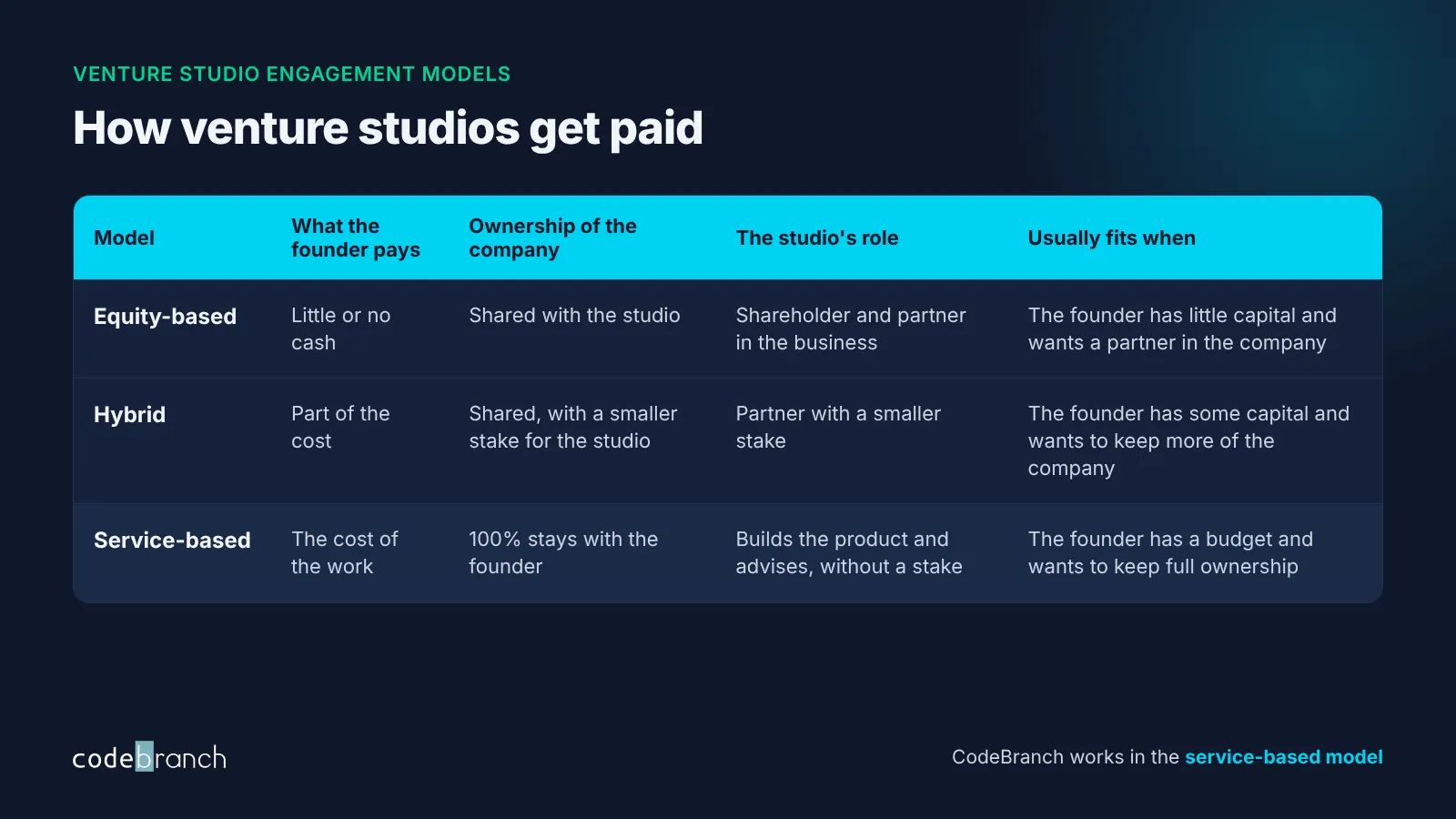
At CodeBranch we work in the service-based model. We do not invest directly in our clients’ companies, and the founder owns all the source code, documentation, infrastructure configurations and intellectual property. For founders who are preparing to raise capital, we prepare the technical material that investors usually ask for: architecture documentation, technical due diligence support, a roadmap and working demos.
How the Process Works, From Idea to Launch
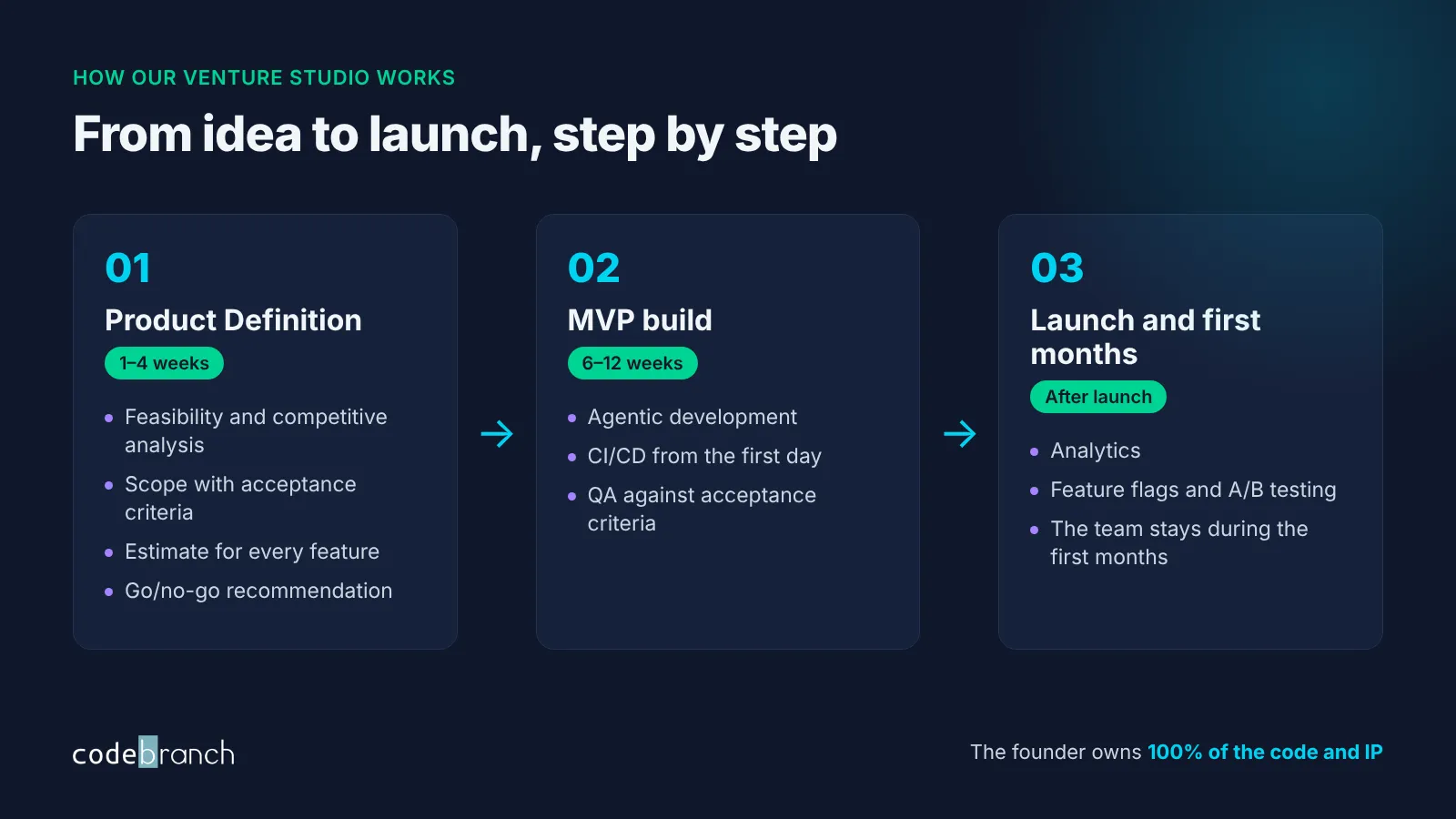
Every studio has its own process. This is how it works in our venture studio for non-technical founders, as a reference of what to expect.
1. Product Definition (1 to 4 weeks)
We assess the feasibility, analyze the competition and define the scope. Every requirement becomes a set of tasks with acceptance criteria that the founder approves before any code is written. Each feature is estimated in our own project management platform, based on historical data, and the phase ends with a feature-by-feature estimate and a go/no-go recommendation.
2. MVP Build (6 to 12 weeks)
The time depends on the scope. We build with agentic development for the scaffolding, the APIs and the testing, and the CI/CD pipeline is in place from the first day.
3. Launch and the First Months
We set up analytics, feature flags and A/B testing, and the team stays during the first months after launch, which are critical for the product.
7 Questions to Ask Before You Choose a Venture Studio
1. Will you help me validate the idea before writing code?
A validation phase should end with a defined scope, an estimate for each feature and a clear go/no-go recommendation. In this way, you decide with information before the biggest part of the budget is committed.
2. Can I click through a prototype before development starts?
Wireframes and an interactive prototype tested with real users show problems that are hard to see in a document. In my opinion, that is the best moment to change things, before the build budget is committed.
3. Can I see an estimate per feature?
With a price for each feature, you can decide what goes into the first version and what can wait. A single total number makes those decisions very hard, because you only see the price of everything together.
4. Do I need to hire a CTO to work with you?
For a non-technical founder, a studio should bring a senior tech lead and a project manager from the first day, covering the architecture, the technology selection and the roadmap until the company is ready to build its own technical team.
5. Who owns the code and the IP at the end?
Ask it before signing and check that the answer is in the contract: source code, documentation, infrastructure configurations and intellectual property. If the studio takes equity, ask also which percentage and under which conditions.
6. Will you stay after launch?
The first months with real users are when the product changes the most. Ask who will take care of the analytics, the fixes and the new iterations, and how that support is organized.
7. I built a prototype with Lovable, Bolt or Cursor. Do I start over?
Not necessarily. A good partner reviews what you already have, keeps what works and builds the production layer underneath it: tests, CI/CD, monitoring and security. At CodeBranch we do this through our Vibe to Production service.
What a Production-Minded Partner Does Differently
An MVP is the first version of a product that real users will depend on, and in my opinion it should be built with that in mind from the start. In our projects that means three things.
First, the pipeline. Every project has its CI/CD, automated tests and code quality gates from the first day, and the AI agents work with written rules and with the acceptance criteria of each requirement.
Second, quality from the beginning. Since one of our first projects, we start the quality review as close as possible to the beginning of development, and QA validates every delivery against its acceptance criteria.
Third, an architecture prepared to grow, with production-grade APIs, database schemas and authentication.
One example is a healthcare startup that came to us with a clinical assistant that relied on a single, manually crafted prompt. It worked for demos, but it was not ready for real clinical use. Our team designed a multi-node LLM agent with LangGraph, built a mobile-friendly web app and set up CI/CD with automated code quality gates from day one. The full MVP was delivered ahead of schedule, with additional functionality beyond the original scope.
Where to Start
If you are a non-technical founder with an idea or a first prototype, I would start with the seven questions above, with us or with any other studio. And if you want to talk about your next step, you can find us here.
CodeBranch is an agentic software development partner for U.S. companies, from building new products to scaling existing ones. Senior-led teams in Colombia, working U.S. hours, deliver with AI-native pipelines and our own Spec-Driven Development framework, with quality and security built into every line of code. codebranch.co
Frequently Asked Questions
Do venture studios take equity?
How long does it take to build an MVP?
Do I need a technical co-founder to work with a venture studio?
I already built a prototype with AI tools. Do I need to start over?
Who owns the code when the project ends?
Jorge A. Mora
CodeBranch is an agentic software development partner for U.S. companies, from building new products to scaling existing ones — senior-led teams in Colombia, working U.S. hours. We deliver with AI-native pipelines and our own Spec-Driven Development framework, with quality and security built into every line of code.