Quick Summary
- ▸ Built for a electrical construction company (201 employees) in Medellin, Colombia.
- ▸ How CodeBranch built a custom budget control and Unit Price Analysis system for a 201-employee electrical construction company in Medellín — materials, labor, procurement, warehouses, progress reports and budget-vs-actual variance in one tool.
- Projects came under budget control — the company could prove at any moment during execution what projects were actually costing.
- Faster quoting — with the materials master and Unit Price Analysis library in place, pricing a new project became assembly instead of research.
Overview
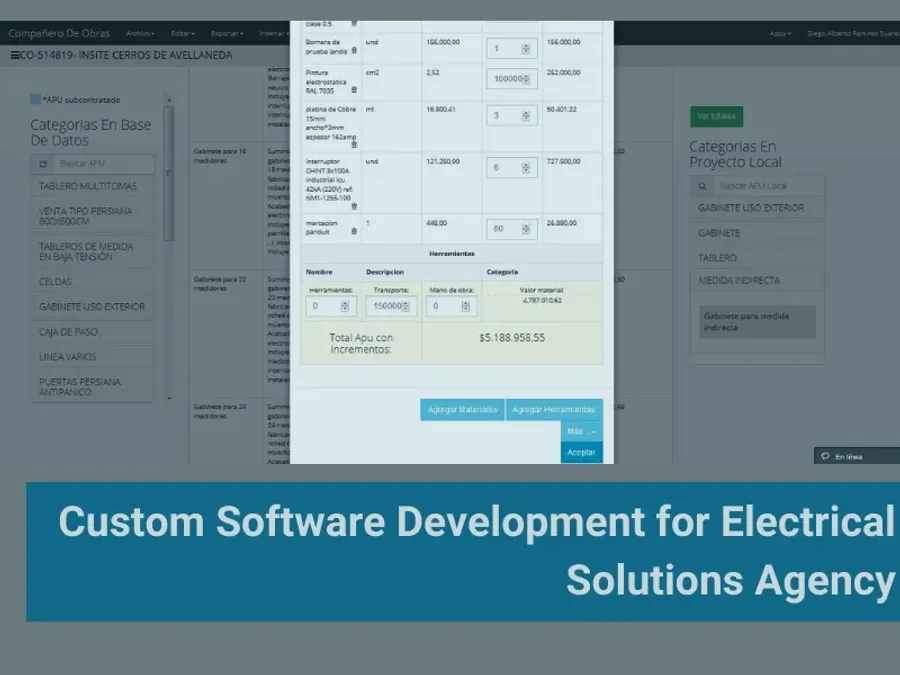
Electrical construction is a business of thousands of small decisions. Almost nothing on a job site is a single line item: every unit of installed work is a set of materials plus the labor to put them in place. Multiply that across a set of blueprints and you have a budget with tens of thousands of moving parts, any one of which can quietly drain the project's margin. The client, an electrical solutions company with 201 employees operating out of Medellín, knew what its projects should cost. What it did not have was a way to prove, at any moment during execution, what they were actually costing. CodeBranch built that system: a custom web application that turns a set of drawings into a priced, controlled budget and then tracks reality against it, day by day, until the project closes.
Industries
Services Provided
- Web Development
- Custom Software Development
- Product Definition
Approach
The decision to build instead of buy was deliberate. What existed on the market was costly, and what the company needed was specific: Unit Price Analysis as the basis of every budget, biweekly progress reports as the basis of every bill, and a material and labor structure that mirrored how this company executed electrical work. The project started small — one idea from the CEO, a modest development budget — and grew feature by feature as the operation leaned on it. Growth was driven by use, not by a roadmap written in advance. CodeBranch ran three collaborative discovery sessions with the CEO to translate operational vision into technical requirements, producing requirements documentation, wireframes and mock-ups before a line of production code was written — the same definition-first discipline that became CodeBranch's Spec-Driven Development framework.
Results
- Projects came under budget control — the company could prove at any moment during execution what projects were actually costing.
- Faster quoting — with the materials master and Unit Price Analysis library in place, pricing a new project became assembly instead of research.
- Supply operations under management — purchase history, supplier pricing and warehouse movements stopped being tribal knowledge.
- Material shrinkage, slow fronts and labor burn rates became visible early enough to act on, while there was still budget to protect.
- The tool became the company's operational backbone — leadership knew at any moment how much money the project had, how much it had spent and why.
- "We managed to get our projects in control, and now we have a tool that allows us to quote projects faster and also control supply operations." — CEO
- "I really liked their approach and they have become a part of our team." — CEO