
The Importance of Software for Construction Estimating in Modern Projects
CodeBranch Team
In the construction industry, accurate and timely cost estimates are essential for project success. Miscalculations or delays in estimating can lead to cost overruns, delayed projects, or even a loss of business. Traditional methods of construction estimating, which often relied on manual spreadsheets and complex calculations, have given way to more efficient and reliable solutions: software for construction estimating.
Quick Summary
- Why traditional, manual construction estimating creates cost and schedule risk
- What construction estimating software actually does and the core features that separate strong platforms from weak ones
- The concrete benefits contractors see in accuracy, speed, and bid competitiveness
- How to evaluate which estimating software actually fits your company and project type
At CodeBranch, we understand the evolving needs of the construction industry, and how technology plays a crucial role in driving efficiency, reducing errors, and improving project outcomes. We have extensive experience in the construction industry and our teams have developed software for construction estimating. Below are the case studies you can explore.
- Budget control system
- Home technology refurbishment Mobile App
- Designing and budgeting home technology refurbishment projects
In this blog, we’ll explore the importance of construction estimating software, the key features to look for, and the benefits it brings to construction professionals.
The Challenges of Traditional Construction Estimating
Before the rise of digital solutions, construction estimators relied heavily on manual processes, including paper-based methods and spreadsheets. While these methods were functional, they were often time-consuming, prone to error, and lacked the flexibility needed to keep up with project complexities.
Some of the key challenges of traditional estimating methods include:
- Human Error: Manual entry and complex calculations are more prone to mistakes. A small error can compound over time, leading to inaccurate estimates and misaligned budgets.
- Inefficiency: With spreadsheets and manual calculations, the estimation process can be slow and cumbersome. This inefficiency makes it difficult to quickly adjust to changing project requirements or bid deadlines.
- Data Silos: Manual methods often lead to information being stored in different places — spreadsheets, documents, or even physical files. This fragmentation makes it hard to collaborate or maintain a single source of truth.
- Lack of Real-Time Data: Traditional methods lack the ability to pull in real-time data such as material costs or labor rates, which can vary over time and lead to inaccurate estimates.
Construction estimating software was developed to solve these problems and introduce more reliable, streamlined processes to construction project management.
What Is Construction Estimating Software?
Construction estimating software is a digital tool that helps construction companies create accurate cost estimates for their projects. These platforms automate the complex calculations involved in determining the costs of labor, materials, equipment, and overhead, based on a project’s scope.
In addition to generating accurate cost projections, these systems often include project management features that allow contractors to adjust their estimates as project specifications change.
Key Features of Construction Estimating Software
Not all estimating software is created equal. There are several core features that good construction estimating software should provide to support project teams in their day-to-day operations.
- Automated Cost Calculations. The most important feature of estimating software is the ability to quickly generate accurate cost estimates. This includes automating the calculation of material, labor, and equipment costs, as well as factoring in additional expenses like permits and overhead. The automation of these calculations significantly reduces the potential for error.
- Integration with Supplier Databases. Material prices fluctuate, which can make estimating a moving target. Estimating software that integrates with supplier databases allows contractors to access real-time pricing information, ensuring that their estimates reflect current market conditions.
- Customizable Templates. Many projects have similar components, but no two projects are identical. Estimating software should allow for customizable templates so that users can create consistent estimates while still tailoring them to the specific needs of each project.
- Collaboration Tools. Construction projects involve multiple stakeholders, including architects, engineers, subcontractors, and clients. Estimating software with collaboration tools can improve communication by allowing teams to share estimates, track changes, and provide input throughout the estimation process.
- Bid Management. Estimating software often includes bid management features, allowing contractors to submit multiple bids and track responses from clients. This helps companies manage their proposals more effectively and avoid missing out on opportunities.
- Historical Data and Reporting. The ability to track and analyze historical data is essential for creating better estimates over time. Estimating software often includes reporting features that allow users to analyze previous projects, compare estimates with actual costs, and identify trends or inefficiencies.
- Cloud-Based Access. In today’s fast-paced work environments, cloud-based solutions are critical. Cloud access allows team members to collaborate in real-time, make updates from any location, and access the most up-to-date versions of estimates, improving accuracy and efficiency.
According to Autodesk’s 2026 Construction Estimating Software Guide, platforms that integrate real-time supplier pricing and cloud-based collaboration consistently reduce estimating cycle time and improve bid accuracy compared to spreadsheet-based workflows — making these two features the ones most correlated with measurable estimating improvements.
Benefits of Using Construction Estimating Software
Now that we’ve reviewed the features of a robust construction estimating solution, let’s look at the benefits that construction professionals can expect.
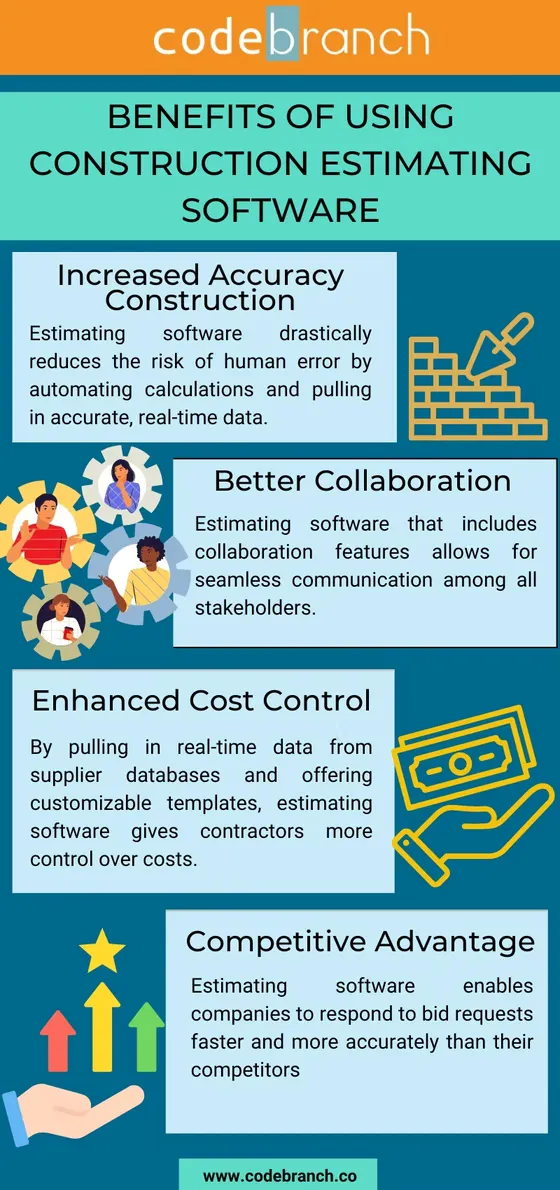
- Increased Accuracy. Construction estimating software drastically reduces the risk of human error by automating calculations and pulling in accurate, real-time data. With more precise estimates, companies can better align their budgets and reduce the risk of cost overruns.
- Time Savings. Manual estimation methods can take hours or even days to complete, especially for complex projects. Estimating software can streamline this process, generating detailed cost projections in a fraction of the time. This enables contractors to submit bids faster and improves their chances of winning contracts.
- Better Collaboration. Estimating software that includes collaboration features allows for seamless communication among all stakeholders. With access to the same data, teams can work more cohesively, reducing misunderstandings and improving decision-making throughout the project lifecycle.
- Enhanced Cost Control. By pulling in real-time data from supplier databases and offering customizable templates, estimating software gives contractors more control over costs. It allows for quick adjustments when project specifications change, helping to ensure that the budget remains aligned with project goals.
- Improved Project Management. Many estimating software platforms integrate with other construction management tools, such as scheduling and project management software. This integration enables better project oversight, allowing teams to monitor the progress of a project against the original estimate and adjust accordingly.
- Competitive Advantage. In the competitive construction industry, speed and accuracy are critical. Estimating software enables companies to respond to bid requests faster and more accurately than their competitors, giving them a leg up in winning contracts. Additionally, the ability to track and compare historical data gives companies insights that can inform future bids and improve profitability.
How Do You Choose the Right Construction Estimating Software?
Selecting the right construction estimating software for your business depends on several factors:
- Size of your company: Smaller companies typically need a more straightforward solution focused on core estimating, while larger enterprises managing complex, multi-site projects usually require advanced features like integrations with ERP, scheduling, and procurement systems.
- Type of projects: Some estimating tools are purpose-built for residential work, others for commercial or heavy infrastructure. Choosing software tailored to your specific project type avoids paying for features you’ll never use.
- Budget: Estimating software typically pays for itself through reduced rework and faster bid turnaround, but it’s still essential to choose a solution that fits within your budget without compromising on the specific features your team actually needs.
- Ease of use: Software adoption stalls when a platform is too complex for the team to use confidently. Select a platform that is intuitive by default and that comes with training or support to help your team get up to speed quickly.
What If Off-the-Shelf Estimating Software Doesn’t Fit Your Workflow?
Off-the-shelf estimating platforms work well when a company’s pricing logic, supplier relationships, and approval workflows fit a standard mold. Many construction businesses don’t fit that mold — they need the estimating tool to sit on top of an existing ERP, follow a specific unitary price analysis method, or integrate with proprietary supply chain processes that no commercial platform supports out of the box.
CodeBranch Software Development service starts with a Product Definition phase that maps your exact estimating workflow before a single line of code is written, then builds a system that fits how your business actually operates — not the other way around.
Final Thoughts
Construction estimating software has reshaped how the industry approaches cost projection in today’s fast-paced and competitive market. By providing accurate, real-time data and automating key processes, this software not only saves time but also helps construction companies stay within budget and win more bids. As construction projects grow more complex, adopting advanced digital tools is no longer an option but a necessity.
CodeBranch is an agentic software development boutique based in Medellin, Colombia, with more than 20 years of engineering experience across the construction industry — from budget control systems to project estimation tools. Whether you’re a construction company seeking to improve project outcomes or an IT team looking for expert development support, our dedicated nearshore teams work within US time zones to help you navigate construction technology, with the cost advantage of being based in Colombia.
Written by the CodeBranch team — Medellin, Colombia. CodeBranch specializes in agentic software development and custom solutions for the construction industry, including budget control and cost estimating systems. codebranch.co
Frequently Asked Questions
What should I look for when hiring a developer for construction estimating software?
How does AI improve construction cost estimating?
Can construction estimating software integrate with tools we already use?
What's the difference between off-the-shelf estimating software and a custom-built system?
Is CodeBranch a good fit for a construction company that needs a custom estimating tool?
How long does it take to build a custom construction estimating tool?
CodeBranch Team
CodeBranch is an agentic software development partner for U.S. companies, from building new products to scaling existing ones — senior-led teams in Colombia, working U.S. hours. We deliver with AI-native pipelines and our own Spec-Driven Development framework, with quality and security built into every line of code.