
Supply Chain Meets Healthcare: How US Health Systems Are Fixing Their Operations Software
CodeBranch Team
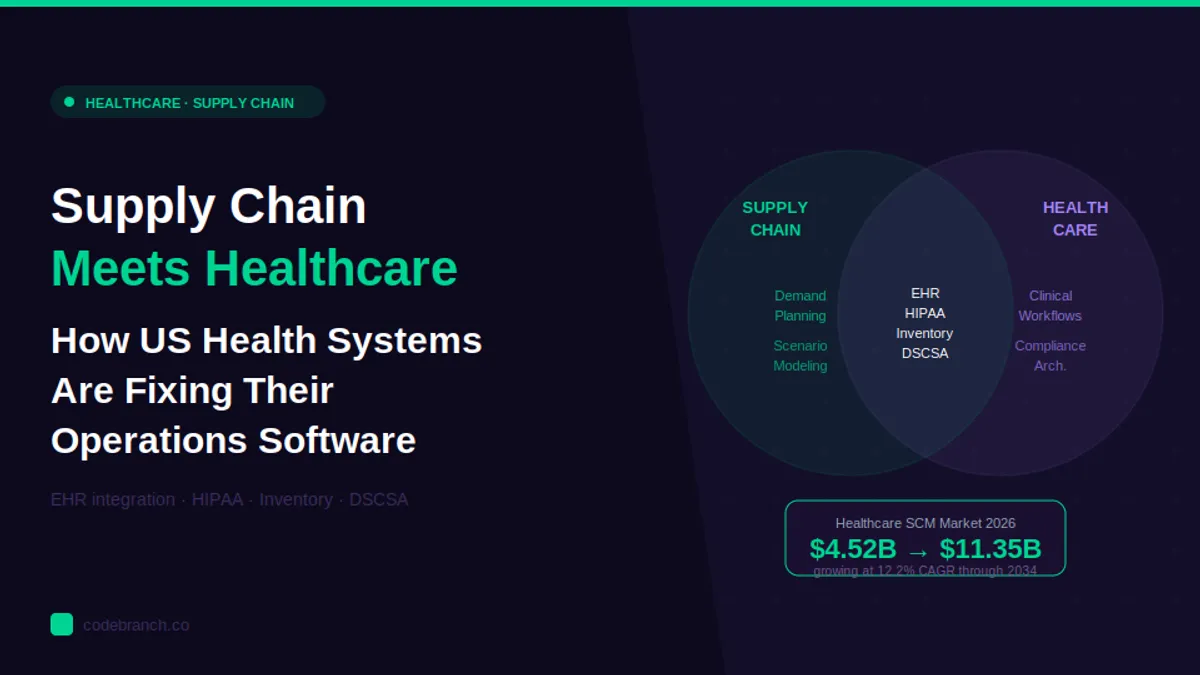
When people talk about healthcare AI, the conversation usually centers on clinical applications — diagnostic tools, documentation assistants, patient-facing systems. What gets less attention is the operational layer underneath: how medical supplies get ordered, how inventory is tracked across multiple facilities, how pharmaceutical procurement connects to patient demand. That operational layer is where a significant number of health systems are struggling — and where a growing market of software is trying to help. The global healthcare supply chain management market is projected to grow from $4.52 billion in 2026 to $11.35 billion by 2034, growing at 12.2% annually. North America accounts for nearly half of that market. The growth reflects something concrete: health systems are actively replacing the manual, fragmented processes that have run their operations for decades — and they need software to do it.
Quick Summary
- Healthcare supply chain is a fundamentally different problem than traditional supply chain — clinical demand signals, patient-safety consequences of stockouts, regulatory compliance, and fragmented multi-facility data change every assumption
- US health systems in 2026 are investing in three categories: real-time inventory visibility, AI-powered demand sensing, and compliance and traceability infrastructure
- Building at this intersection is technically complex: EHR integration, HIPAA in non-obvious places, multi-facility data normalization, and event-driven infrastructure all compound
- CodeBranch brings supply chain engineering depth and healthcare compliance experience simultaneously — and starts every engagement with a Product Definition phase before any code is written
Why Healthcare Supply Chain Is a Different Problem Than Traditional Supply Chain
Supply chain software for retail, manufacturing, or logistics deals with complexity — but it’s complexity that follows relatively predictable patterns. Demand signals are external and measurable. Supplier relationships are commercial. The consequences of a stockout are financial. Healthcare supply chain operates under constraints that change the problem fundamentally.
- Clinical demand is not commercial demand. A hospital’s need for a specific surgical implant, medication, or diagnostic reagent isn’t driven by market signals — it’s driven by patient volume, clinical protocols, and physician preferences that are difficult to forecast using the same models that work in retail. A product that’s in stock but not the right SKU for a specific procedure is effectively out of stock.
- The cost of a stockout is not financial — it’s clinical. According to USP analysis of FDA shortage data, nearly 75 drugs were in shortage at the end of 2025. A hospital that runs out of a critical medication or implant during a procedure faces consequences that go beyond a missed sale. The software managing that inventory has to treat availability as a safety constraint, not just an efficiency metric.
- Regulatory requirements layer compliance onto every transaction. The Drug Supply Chain Security Act (DSCSA) requires unit-level serialization and traceability for pharmaceutical products. Medical device tracking, lot number management, expiration date monitoring, and recall response are all compliance requirements that a healthcare supply chain platform has to handle natively.
- Data lives in too many places. Inventory management is projected to account for 40% of the healthcare supply chain management market share in 2026 — because stock accuracy must improve before wider procurement automation can scale. Most health systems manage inventory across multiple facilities, multiple EHR systems, and multiple supplier relationships — none of which share a common data standard.
What US Health Systems Are Actually Buying in 2026
Three categories are seeing the most investment from health systems right now.
- Inventory management and real-time visibility platforms. The largest single category — hospitals and health systems are anticipated to capture 43% of healthcare supply chain software market share in 2026. The systems being replaced are typically a combination of spreadsheets, EHR-adjacent modules, and manual counts. The systems being built connect barcode scanners, RFID, and purchasing data into a single source of truth.
- AI-powered demand sensing and procurement platforms. The FDA shortage data points to a structural problem: health systems can’t predict demand well enough to maintain appropriate stock levels for critical items. AI-powered demand sensing tools analyze patient census data, procedure schedules, historical consumption, and supplier lead times to generate forward-looking procurement recommendations. [Source: Mordor Intelligence]
- Compliance and traceability infrastructure. DSCSA serialization requirements and expanding recall management obligations are driving health systems to build or buy platforms that track products at the unit level from manufacturer to patient. This is less a supply chain tool than a compliance tool — but it lives in the supply chain data layer and has to connect to the same inventory and procurement systems.
What Makes Building This Software Technically Complex
Healthcare supply chain software sits at the intersection of two domains that are each technically demanding on their own. Together, they produce a set of constraints that most development teams don’t fully anticipate.
- EHR integration is harder than it looks. The inventory and procurement data that a supply chain platform needs — procedure schedules, clinical consumption, physician preference cards — lives inside EHR systems. Getting that data out in a usable format requires working with HL7 and FHIR standards, navigating proprietary APIs, and handling data quality issues accumulated over years of manual entry.
- HIPAA intersects with supply chain data in non-obvious ways. Patient-linked consumption data — which products were used in which procedures for which patients — falls under HIPAA protections even when the primary purpose is inventory management. A supply chain platform that pulls that data for demand forecasting has to handle it with the same compliance architecture as a clinical system.
- Multi-facility data aggregation is a different problem than single-site tracking. A health system with ten hospitals and sixty clinics doesn’t have a unified inventory. It has ten different inventory systems, potentially running on different EHR platforms, with different purchasing workflows and different supplier relationships. Building a visibility layer on top of that requires data normalization work that is less glamorous than the AI forecasting layer — but without it, the AI layer doesn’t have reliable data to work with.
- Real-time visibility requires infrastructure decisions with long-term consequences. A platform that surfaces inventory status across a network in real time needs an event-driven architecture, appropriate message queue design, and database choices that handle the write volume of a busy health system. Those infrastructure decisions, made early in the build, determine whether the platform scales with the health system or becomes a bottleneck as the network grows.
Where CodeBranch’s Supply Chain and Healthcare Experience Intersect
CodeBranch has built software in both verticals — separately, and with the kind of depth that comes from delivering in production environments where the stakes are high. On the supply chain side, CodeBranch has built AI-powered demand prioritization platforms, what-if scenario assessment tools, and an AI agent for supply chain decision-making — all for semiconductor and hardware companies managing complex, multi-variable supply chains. The engineering capabilities developed there — constraint-based optimization, real-time data pipelines, scenario modeling — transfer directly to the healthcare supply chain context.
On the healthcare software side, CodeBranch has built systems that operate inside the specific constraints of clinical environments: HIPAA compliance architecture, EHR integration, and the adoption requirements of clinical teams who have no tolerance for tools that add friction to their workflows. Healthcare supply chain requires both capability sets simultaneously — the data pipeline and optimization expertise of supply chain software, combined with the compliance architecture and EHR integration experience of healthcare software. CodeBranch is an agentic software development boutique and nearshore development partner based in Medellín, Colombia, and every healthcare supply chain engagement starts with a Product Definition phase that maps the clinical data flows, compliance requirements, and integration architecture before development begins.
Written by the CodeBranch team — Medellín, Colombia. CodeBranch specializes in agentic software development and nearshore dedicated teams for US product companies at the intersection of healthcare operations and supply chain software. codebranch.co
CodeBranch is an agentic software development boutique and nearshore development partner based in Medellín, Colombia. We specialize in building AI-optimized development pipelines for product teams in the United States — from new product builds to AI transformation sprints to dedicated nearshore teams. With 20+ years of engineering experience and 10+ years delivering AI solutions, we work within US time zones with the cost advantage of being based in Colombia. codebranch.co
Frequently Asked Questions
What is healthcare supply chain management software?
Why do health systems need custom supply chain software instead of generic platforms?
Is CodeBranch a good fit for health systems that need to connect supply chain data with EHR systems?
How does CodeBranch handle HIPAA compliance in supply chain software that touches patient data?
What engagement model does CodeBranch use for healthcare supply chain software projects?
CodeBranch Team
CodeBranch is an agentic software development partner for U.S. companies, from building new products to scaling existing ones — senior-led teams in Colombia, working U.S. hours. We deliver with AI-native pipelines and our own Spec-Driven Development framework, with quality and security built into every line of code.