
Nearshore Software Development for Logistics and Supply Chain Technology
CodeBranch Team
In today’s fast-paced global economy, technology is transforming the logistics and supply chain industry like never before. Efficient management of warehouses, fleets, and transportation routes has become critical for businesses to stay competitive. This is where specialized logistics software developers play a vital role, creating innovative solutions tailored to meet the complex demands of modern supply chains.
Partnering with a skilled nearshore logistics tech team offers companies the advantage of cost-effective, high-quality software development with seamless communication and cultural alignment. From warehouse software to fleet management software and transportation app development, technology is driving the future of logistics.
In this blog, we’ll explore how advanced logistics solutions and expert software development teams are revolutionizing supply chain operations, boosting efficiency, and enabling smarter decision-making across the board.
U.S. Logistics Companies Shaping the Future of Supply Chain
Here are some of the key logistics companies in the U.S. that are making an impact in the industry.
Expeditors International of Washington, Inc.
Founded in 1979, Expeditors is a global logistics company headquartered in Seattle, USA. It specializes in customized logistics solutions including air and ocean freight forwarding, customs brokerage, warehousing, and distribution.
Known for its strong focus on technology and customer service, Expeditors leverages advanced supply chain software and data analytics to optimize global trade and improve operational efficiency. The company’s commitment to integrating innovative logistics solutions positions it as a leader in the freight and supply chain management sector.
Hyde Shipping
Hyde Shipping is a specialized logistics company focused on providing reliable freight forwarding and supply chain services, primarily within Latin America. With a strong presence in the region, Hyde Shipping offers tailored solutions including cargo transportation, customs clearance, and warehousing.
The company emphasizes personalized customer service and efficient logistics management, leveraging modern technologies to ensure timely delivery and seamless coordination. Hyde Shipping’s regional expertise and commitment to quality make it a trusted partner for businesses seeking effective logistics solutions in LATAM.
Edge Logistics
Edge Logistics is a comprehensive logistics service provider specializing in supply chain management, freight brokerage, and transportation solutions across North America. The company offers end-to-end services including warehousing, distribution, and advanced fleet management, supported by cutting-edge logistics software.
Edge Logistics focuses on leveraging technology and data-driven insights to enhance supply chain visibility, optimize routes, and improve operational efficiency. Their customer-centric approach and innovative freight tech solutions position them as a key player in the modern logistics landscape.
Manco Logistics Corp
Manco Logistics Corp is a prominent logistics and freight forwarding company operating primarily in Latin America, with a strong focus on providing customized transportation and supply chain solutions. The company offers comprehensive services including cargo handling, customs brokerage, and warehouse management.
Leveraging modern logistics technologies and a deep understanding of regional markets, Mancolog aims to deliver efficient, reliable, and cost-effective logistics solutions tailored to the specific needs of its clients. Their expertise in LATAM logistics makes them a valuable partner for businesses navigating complex supply chains in the region.
Common Challenges Faced by Logistics and Supply Chain Companies
The logistics and supply chain industry is complex and dynamic, with companies facing numerous challenges that can hinder operational efficiency and customer satisfaction.
Some of the most pressing issues include:
- Inventory Inaccuracy: Without proper tools, managing inventory levels can lead to overstocking or stockouts, disrupting order fulfillment and increasing holding costs.
- Inefficient Route Planning: Poorly optimized transportation routes result in higher fuel consumption, delayed deliveries, and increased operational expenses.
- Fleet Downtime and Maintenance Issues: Lack of real-time monitoring and predictive maintenance can cause unexpected vehicle breakdowns, impacting delivery schedules.
- Limited Visibility and Data Silos: Fragmented systems prevent real-time tracking of shipments and inventory, making it difficult to make informed decisions quickly.
- Compliance and Regulatory Pressures: Adhering to safety, environmental, and transportation regulations requires continuous monitoring and reporting, often straining resources.
- Rising Customer Expectations: Modern customers demand faster, transparent, and more reliable delivery services, pushing companies to innovate continuously.
Addressing these challenges requires robust and integrated technology solutions designed specifically for the logistics and supply chain environment. The following section explores key software tools that help businesses overcome these obstacles and thrive in a competitive market.
Key Software Solutions for Logistics and Supply Chain
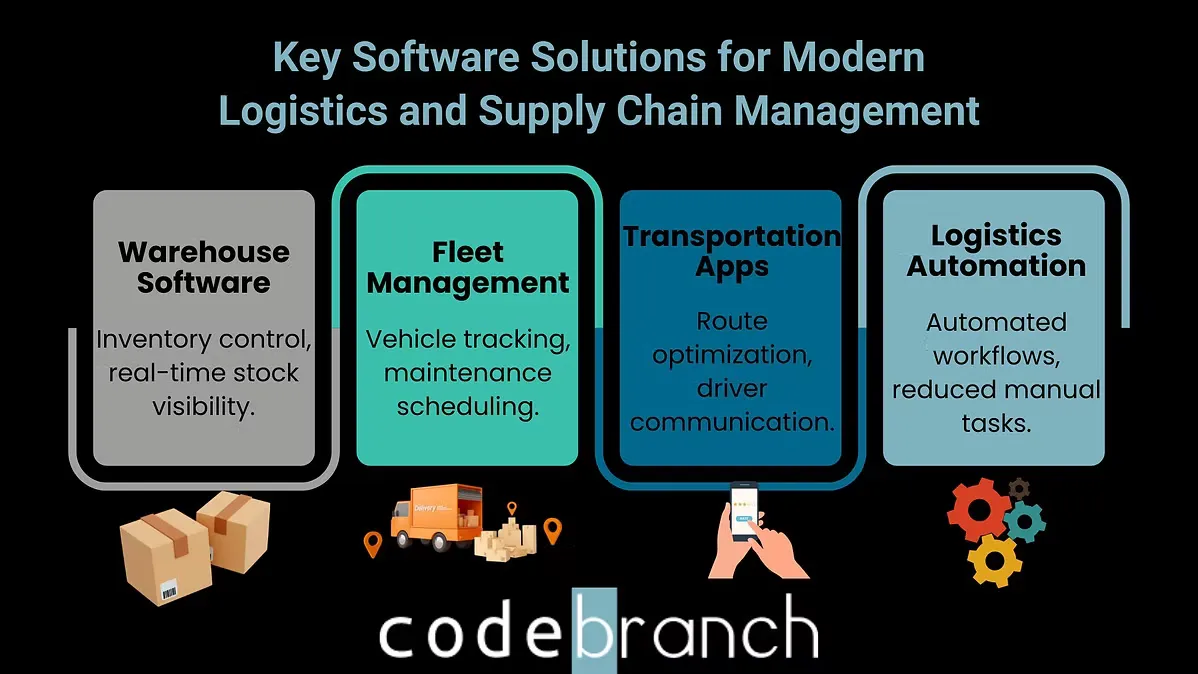
The logistics and supply chain industry relies heavily on specialized software solutions to maintain efficiency and meet customer demands. One of the most critical tools is warehouse software, which helps businesses manage inventory levels, optimize storage space, and streamline order fulfillment. With real-time tracking and automation features, warehouse software reduces errors and improves turnaround times.
Another essential solution is transportation app development, which provides tools for route optimization, shipment tracking, and communication between dispatchers and drivers. These apps enhance delivery accuracy and reduce fuel consumption, contributing to cost savings and improved customer satisfaction.
Additionally, fleet management software plays a crucial role in monitoring vehicle health, scheduling maintenance, and ensuring compliance with safety regulations. This software provides managers with actionable insights to prevent downtime and extend the life of their assets.
Together, these software solutions form the backbone of modern logistics operations, enabling companies to increase productivity, reduce costs, and respond quickly to changing market conditions.
Why Nearshore Development Works for Logistics and Supply Chain
Logistics and supply chain software has to handle real-time data from warehouses, fleets, suppliers, and distribution centers — often across multiple time zones and regulatory environments. Building that kind of system requires engineers who understand both the technical complexity and the operational reality of how goods actually move.
A nearshore team in the same time zone as your operations means standups, code reviews, and blockers get resolved the same day — not the next business day. For logistics platforms where a delayed integration or a broken data pipeline has immediate operational consequences, that responsiveness matters more than in most other industries.
At CodeBranch, we build supply chain and logistics software from Medellín, Colombia (GMT-5) — with 20+ years of engineering experience, dedicated teams that stay with your project, and an agentic development process that delivers working platforms faster without compromising on data integrity or system reliability. We’ve built AI-powered demand prioritization platforms, what-if scenario assessment tools, and real-time supply chain agents for companies managing hundreds of variables across procurement, manufacturing, and distribution.
The result: logistics teams get software built for how their operations actually run — not how a generic SaaS template assumes they should.
Why Outsourcing Supply Chain Software Development Makes Sense
Outsourcing supply chain software development has become a strategic choice for many companies aiming to accelerate innovation while controlling costs. By partnering with specialized software providers, businesses can tap into a wealth of expertise without the overhead of building large in-house teams.
One of the key advantages of outsourcing is access to skilled supply chain devs who understand the complexities of logistics operations and can deliver customized solutions tailored to specific business needs. This expertise ensures faster development cycles and higher quality software.
Additionally, outsourcing offers flexibility to scale resources up or down based on project demands, reducing risks associated with hiring and training permanent staff. Companies also benefit from the latest technologies and best practices brought by experienced development partners.
Choosing a nearshore software development partner further enhances communication and collaboration due to proximity in time zones and cultural alignment. This leads to more efficient project management and quicker response times compared to offshore outsourcing.
Overall, outsourcing supply chain software development enables companies to focus on their core competencies while relying on trusted partners to build and maintain critical logistics software solutions.
Conclusion
In today’s rapidly evolving logistics and supply chain landscape, leveraging technology is essential to stay competitive and meet growing customer demands. Partnering with experienced logistics software developers and nearshore logistics tech teams allows businesses to access specialized skills, accelerate project delivery, and implement cutting-edge solutions like warehouse software, fleet management systems, and transportation apps.
Outsourcing software development, especially through nearshore providers like CodeBranch in Medellín, Colombia, offers the perfect balance of cost efficiency, cultural alignment, and real-time collaboration. This strategic approach empowers companies to innovate faster, optimize operations, and scale their logistics capabilities effectively.
By embracing tailored software solutions and trusted development partnerships, organizations can transform their supply chains into agile, data-driven networks ready to meet the challenges of today and the future.
Frequently Asked Questions
Why choose a nearshore team for supply chain software development?
What supply chain software has CodeBranch built?
How do I evaluate a nearshore partner for logistics software?
CodeBranch Team
CodeBranch is an agentic software development partner for U.S. companies, from building new products to scaling existing ones — senior-led teams in Colombia, working U.S. hours. We deliver with AI-native pipelines and our own Spec-Driven Development framework, with quality and security built into every line of code.