
The Medellin Tech Ecosystem in 2026: Why US Companies Are Building Their Engineering Teams Here
CodeBranch Team
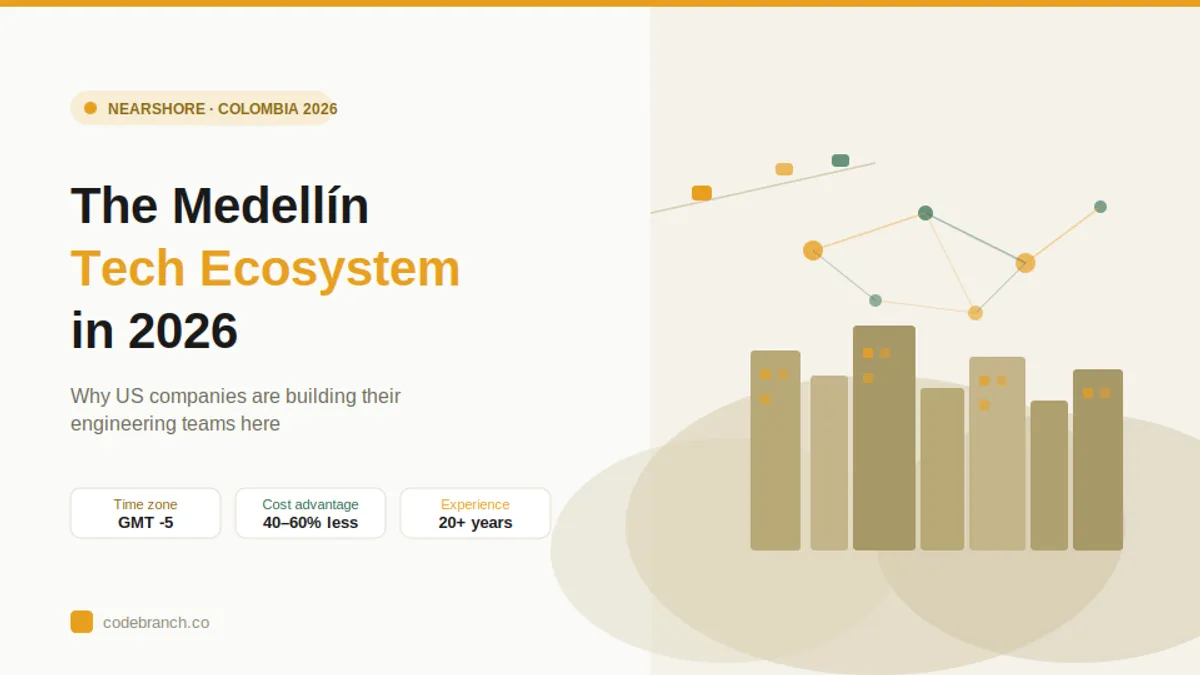
Speaking as the nearshore company from Colombia — the one actually delivering software for US product teams from Medellín — I can tell you that the conversation has changed. Three years ago, US companies asked us whether Colombia was a safe bet. Today, they ask how fast we can start. That shift didn’t happen by accident. It happened because the ecosystem around us matured in ways that make Medellín a genuinely strong place to build engineering teams — not just a cost alternative to US hiring, but a real technical advantage.
Quick Summary
- Medellín’s talent pipeline — from Universidad de Antioquia, EAFIT, and Universidad Nacional — now produces a critical mass of senior engineers with direct US client experience
- Dedicated development teams and staff augmentation are fundamentally different models; the right choice depends on whether the client needs headcount or a self-managing delivery unit
- Agentic development changes the nearshore equation: combining Colombia’s cost advantage with a 5x sprint velocity multiplier shifts total value per dollar dramatically
- The right nearshore partner owns the delivery process, starts with definition before code, aligns commercially to the project stage, and staffs senior engineers by default
What the Medellín Tech Ecosystem Looks Like From the Inside
Medellín has been on “emerging tech city” lists for years. What those lists don’t capture is what the ecosystem actually produces at the engineering level.
The talent pipeline starts at Universidad de Antioquia, Universidad EAFIT, and Universidad Nacional — three institutions with strong computer science and engineering programs that have been producing senior developers for decades. What’s changed in the last three years is the density of experienced engineers with US client exposure. Medellín now has a critical mass of developers who have shipped production software for US teams — worked within their review processes, operated in EST or PST time zones, and delivered features into CI/CD pipelines with real quality gates.
The numbers behind that talent base are significant. Colombia has a pool of 165,000+ IT professionals, with Bogotá, Medellín, and Cali standing out as the country’s top innovation centers, combining thriving startup ecosystems, international investment, and strong universities. In 2024, Colombia rose to the 2nd position in the Latin American startup ecosystem ranking, surpassing Chile — with startups raising $513 million in funding, a 36% increase over 2023.
The infrastructure has followed the talent. Fixed broadband internet speed in Colombia averages 162.6 Mbps for downloads as of early 2025, with fiber-optic coverage expanding from roughly 12% in 2022 to 25% in 2025.
The timezone is GMT-5 — the same as New York and one hour behind Chicago. For a US product team running morning standups and afternoon sprint reviews, that’s a full shared workday. It’s a meaningful difference from teams based in Eastern Europe or Asia.
Dedicated Development Teams vs. Staff Augmentation — Why the Model Matters
When US companies evaluate nearshore development, they often conflate two very different models: staff augmentation and dedicated development teams. The distinction matters more than most companies realize before they start.
Staff augmentation places individual engineers into an existing team structure. The client directs the work, manages the tasks, and owns the engineering process. The nearshore company provides the headcount.
This model works when a company needs to fill a specific skill gap on a short-term basis and has the internal capacity to manage additional engineers directly.
A dedicated development team operates differently. CodeBranch builds and runs the team as a unit through its dedicated team service — with its own engineering lead, QA function, and delivery process — aligned to the client’s product goals but responsible for how the work gets done. The client sets priorities and defines outcomes. CodeBranch owns the execution.
This is the model CodeBranch runs as its dedicated development team service — and the reason we built it this way is straightforward: US product companies that need to extend their capacity don’t need more people to manage. They need a team that can deliver without adding management overhead on the client side.
The practical difference shows up in the first sprint. A dedicated team shows up with a defined process, shared context, and clear accountability for outcomes.
How Agentic Development Changes the Nearshore Equation
The traditional argument for nearshore development was cost and time zone. Both still hold. But agentic software development adds a dimension that changes the output equation significantly.
An agentic development pipeline is one where AI coding agents handle execution concurrently — generating code, running automated tests, auditing output against architectural standards — while senior developers focus on architecture, requirements, and the decisions that require judgment. For a dedicated nearshore team, this means significantly more output per sprint without increasing headcount.
At CodeBranch, we’ve measured a 5x increase in tasks delivered per sprint on engagements where specs were clear and the pipeline was properly configured. That result came from a specific healthcare project tracked over six weeks — not a projection. A senior engineer in the US costs around $125K per year, while the same expertise in Colombia runs about $63K — nearly a 49% difference.
When that cost advantage is combined with an agentic pipeline that multiplies output per engineer, the total value delivered per dollar spent shifts dramatically.
What makes Medellín specifically well-suited to agentic development is the quality of senior engineers available. Agentic pipelines require architects who can define the rules that govern agent behavior — what agents can touch, what they can’t, what patterns trigger human review. That’s a senior-level judgment call that can’t be delegated to the agents themselves.
That talent is available here, and it’s been working with US product teams long enough to understand how they operate.
What to Look for When Evaluating a Nearshore Partner
The right nearshore partner for a US product team is one that makes the collaboration feel like a natural extension of the internal team — not an external vendor relationship that requires constant coordination overhead. A few things that consistently indicate a strong fit:
- The team owns the delivery process. A good dedicated team doesn’t wait to be told what to do next. They flag blockers early, propose solutions before they become problems, and take responsibility for the quality of what they ship.
- The engagement starts with definition, not code. Any team that wants to start writing code before the requirements are clear is optimizing for activity, not outcomes. At CodeBranch, every engagement starts with a Product Definition phase that maps requirements, technical constraints, and delivery milestones before development begins.
- The commercial model aligns with the project stage. For projects at the definition stage, a short fixed-scope engagement makes sense. For ongoing product development, a monthly retainer with a stable dedicated team produces better results than a series of short contracts with rotating resources.
- Senior engineers are the standard, not the exception. The engineers who speak to clients, make architectural decisions, and define agent rules in an agentic pipeline need to be senior. A team that presents senior engineers in the sales process and delivers junior engineers in execution is a mismatch that shows up by week two.
This is how CodeBranch approaches nearshore software development from Medellín — and it’s the standard we’d want applied to us if we were the client evaluating a partner.
Written by Jorge A. Mora, Co-founder and Strategic Partner in Agentic AI at CodeBranch — Medellín, Colombia. Jorge has spent 20+ years building nearshore dedicated development teams for US product companies, and leads CodeBranch’s agentic development practice. linkedin.com/in/jorge-a-mora-codebranch | codebranch.co
CodeBranch is an agentic software development boutique and nearshore development partner based in Medellín, Colombia. We specialize in building AI-optimized development pipelines for product teams in the United States — from new product builds to AI transformation sprints to dedicated nearshore teams. With 20+ years of engineering experience and 10+ years delivering AI solutions, we work within US time zones with the cost advantage of being based in Colombia. codebranch.co
Frequently Asked Questions
What makes Medellín a strong location for nearshore software development in 2026?
How does CodeBranch's dedicated team model differ from staff augmentation?
How does CodeBranch handle the time zone difference with US teams?
Is CodeBranch a good fit for US companies that need agentic development capabilities in a nearshore team?
What engagement model does CodeBranch use for nearshore development projects?
CodeBranch Team
CodeBranch is an agentic software development partner for U.S. companies, from building new products to scaling existing ones — senior-led teams in Colombia, working U.S. hours. We deliver with AI-native pipelines and our own Spec-Driven Development framework, with quality and security built into every line of code.