
How to Evaluate the Ideal Partner to Develop a HealthTech MVP (and a Step-by-Step Guide to Building One)
CodeBranch Team
Bringing a HealthTech solution to market through a Minimum Viable Product (MVP) requires a completely different approach than standard software development. In the healthcare sector, speed to validate an idea cannot come at the expense of data security or regulatory compliance.
A successful HealthTech MVP must balance three core pillars: business agility, robust architecture, and strict regulatory rigor. To achieve this, a development partner’s capabilities must go far beyond just mastering a modern tech stack.
Quick Summary
- Why HealthTech MVPs require a fundamentally different approach than standard software MVPs
- A step-by-step methodology for building healthcare software from scope to launch
- What to evaluate in a development partner — beyond tech stack — for regulated healthcare projects
- How CodeBranch handles HIPAA compliance, BAA execution, and interoperability in practice
At CodeBranch, we are fully prepared for this challenge: we have proven experience building HIPAA-compliant software and executing Business Associate Agreements (BAAs) to assume the legal and operational responsibility required when handling sensitive health data.
Step-by-Step: Building a Successful Healthcare MVP
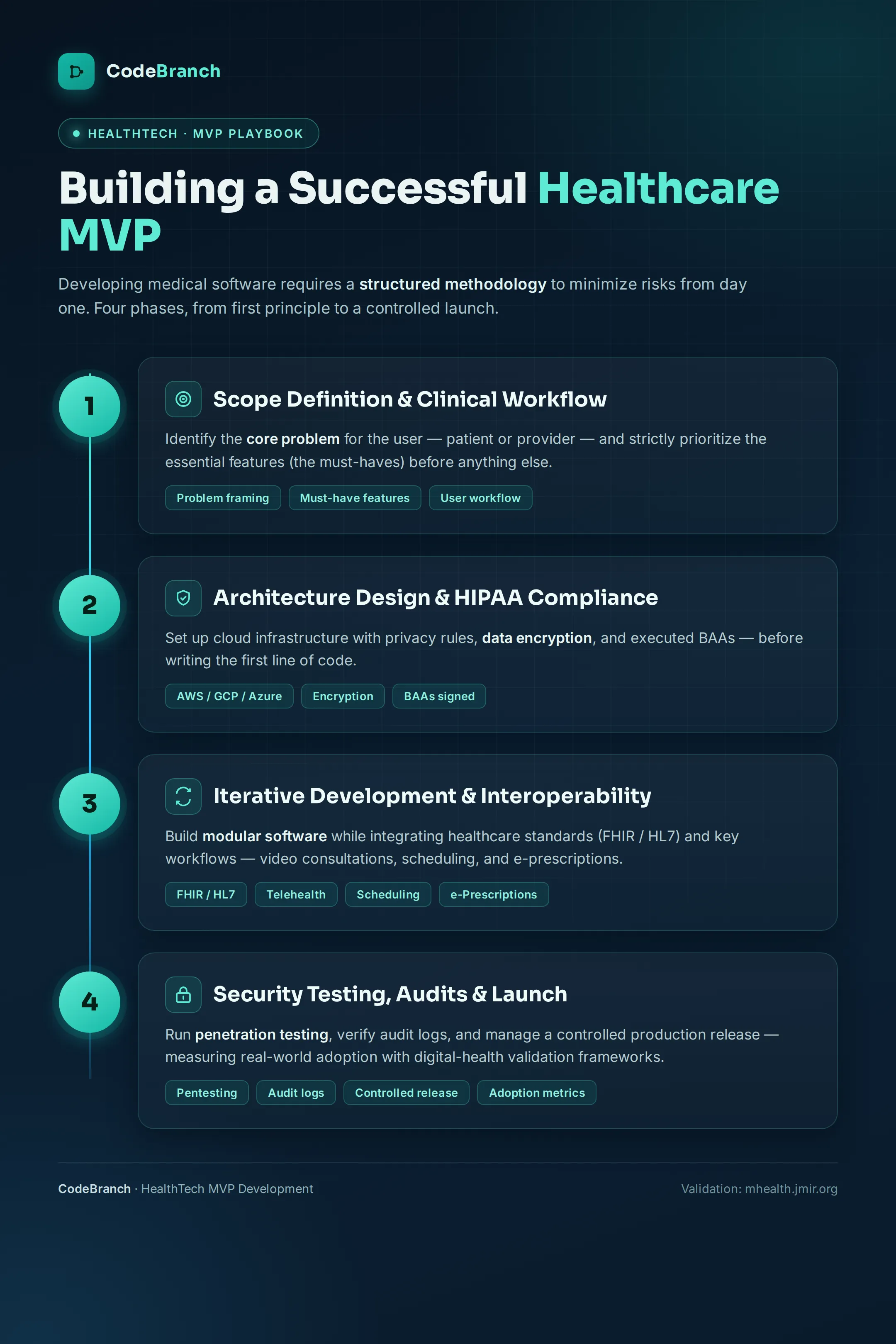
Developing medical software requires a structured methodology to minimize risks from day one:
1. Scope Definition & Clinical Workflow — Identifying the core problem for the user (patient or provider) and strictly prioritizing essential features (must-haves).
2. Architecture Design & HIPAA Compliance — Setting up cloud infrastructure (AWS/GCP/Azure) with privacy rules, data encryption, and executed BAAs before writing the first line of code.
3. Iterative Development & Interoperability — Building modular software while integrating healthcare standards (FHIR/HL7) and key workflows like video consultations, scheduling, or e-prescriptions.
4. Security Testing, Audits & Launch — Executing penetration testing (pentesting), verifying audit logs, and managing a controlled production release to measure real-world adoption using digital health validation frameworks.
What to Look for When Evaluating a Healthcare Development Partner
When selecting the team to build your product, the strongest firms distinguish themselves less by technology stack and more by how they approach regulated healthcare software. Here is what you should evaluate during the process.
1. Healthcare-Specific Experience
Generic marketing pages about “medical software” are not enough. Ask for demonstrations of live platforms that include:
- Patient onboarding
- Video consultations
- Scheduling
- Provider dashboards
- EHR/EMR integration
- eRx (e-prescriptions)
- HIPAA audit logs
At CodeBranch, our healthcare software development capabilities are backed by live product references and operational integrations, ensuring we don’t have to reinvent the wheel when building your MVP.
2. Proactive Security Architecture
A strong partner with true healthcare experience should proactively discuss security. If security only comes up after you ask, that’s a warning sign.
Ensure the team masters and applies advanced security practices:
- Encryption in transit (TLS) and at rest (AES-256)
- Role-Based and Attribute-Based Access Control (RBAC / ABAC)
- Comprehensive and immutable audit trails
- Secrets management and Infrastructure-as-Code (IaC)
- Disaster recovery plans and a Secure Software Development Life Cycle (SDLC) aligned with NIST security guidelines
3. HIPAA Maturity & BAA Execution
Rather than simply asking “Are you HIPAA compliant?”, community discussions from founders who’ve evaluated vendors consistently emphasize probing operational practices:
- Do you sign BAAs? At CodeBranch, we sign BAAs (Business Associate Agreements) with our clients, taking formal and legal responsibility for safeguarding Protected Health Information (PHI).
- How do you handle PHI in development and staging? Utilizing data anonymization and synthetic data.
- What is your incident response process?
- How are developer laptops secured, and how is production access controlled?
4. Interoperability Expertise
A healthcare MVP rarely operates in isolation; it must communicate with the broader medical ecosystem — especially as federal interoperability mandates continue to expand. Look for practical familiarity with:
- Standards: FHIR, HL7 v2, and SMART on FHIR.
- Leading EHR Systems: Epic, Oracle Health (Cerner), athenahealth, eClinicalWorks, among others.
Ask directly which integrations they’ve implemented before and under what data exchange scenarios.
Case Study: AI-Powered Clinical Assistant for Emergency Care
A healthcare startup approached CodeBranch with a working proof-of-concept built on a manually crafted prompt. While it demonstrated the core idea, the architecture was not suitable for production. The goal: evolve it into a robust, commercializable platform ready for real-world use by physicians in emergency care.
CodeBranch designed and developed a mobile-friendly web application powered by a multi-node LLM agent built with LangGraph. The platform supports multiple clinical scenarios — including live consultation assistance, on-demand clinical chat, and an academic reference mode — all tailored for medical professionals.
Key results:
- Full MVP delivered ahead of schedule, with additional functionality beyond the original scope
- Scalable production environment with CI/CD pipeline and code quality gates
- Internal beta testing underway with cross-functional medical teams
- Platform ready for showcase at an international medical congress
Stack: Python, FastAPI, LangGraph, PostgreSQL, pgvector, Next.js, TypeScript, Tailwind CSS, Docker, SonarCloud.
Build Your HealthTech MVP with CodeBranch
Building healthcare software requires a partner who not only knows how to code but also deeply understands legal frameworks, patient privacy, and interoperability demands.
At CodeBranch, we combine deep experience in HIPAA-compliant development, readiness to sign BAAs, and an agile execution model focused on launching your MVP quickly and securely.
Have a HealthTech idea you’re ready to structure? Let’s talk and design the roadmap for your MVP.
Written by the CodeBranch team — Medellin, Colombia. CodeBranch specializes in agentic software development for healthcare companies — from HIPAA-compliant platforms to clinical AI systems and telehealth solutions. codebranch.co
Frequently Asked Questions
What is a HealthTech MVP?
Does CodeBranch sign BAAs for healthcare projects?
How long does it take to build a HealthTech MVP?
What EHR systems has CodeBranch integrated with?
CodeBranch Team
CodeBranch is an agentic software development partner for U.S. companies, from building new products to scaling existing ones — senior-led teams in Colombia, working U.S. hours. We deliver with AI-native pipelines and our own Spec-Driven Development framework, with quality and security built into every line of code.