Quick Summary
- ▸ Built for a transit technology company (10–20 employees) in New York, United States.
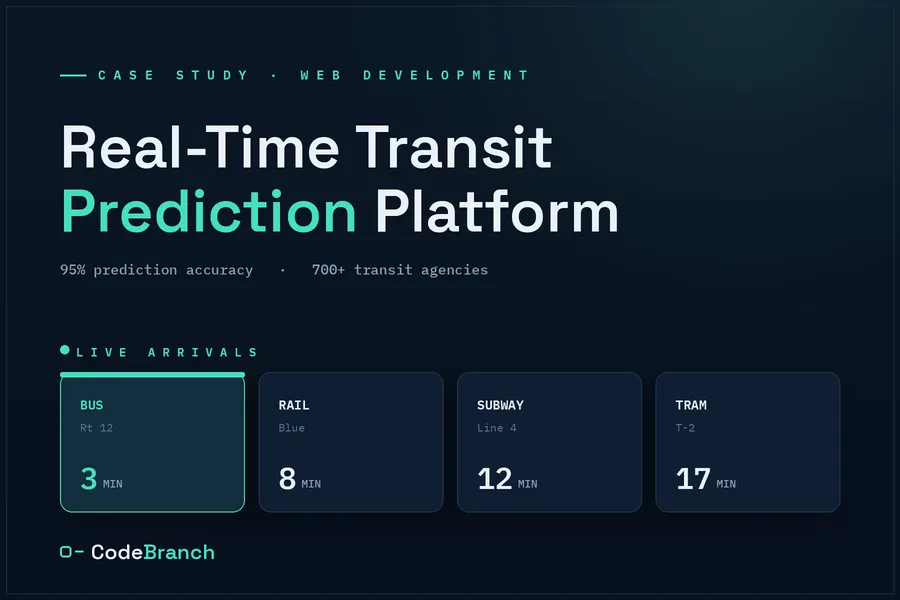
- ▸ CodeBranch rebuilt the prediction engine behind live arrival boards at bus stops and train stations across the U.S., achieving 95% accuracy and automating data ingestion from 700+ transit agencies.
- 95% prediction accuracy — up from a baseline too unreliable to measure
- 700+ transit agencies feeding live arrival data into the platform
Overview
A real-time transit platform powers the live arrival boards at bus stops, train platforms, and transit stations across the U.S. The system feeds the countdown displays that tell passengers when the next service is arriving — and the accuracy of every screen depends on how well the backend predicts what's actually coming.
CodeBranch rebuilt the prediction engine and automated the data pipeline in two consecutive projects. The first delivered a new algorithm that predicts arrivals down to the second across buses, trains, subways, trams, and cable transit. The second eliminated the manual data ingestion process, replacing a daily "publish" ritual with automated validation and self-protecting data flows across 700+ independent agency databases.
The engagement was delivered by a dedicated four-person CodeBranch team — a project manager, software architect, developer, and QA specialist — working as a coordinated unit across both projects over approximately 12 months.
Industries
Services Provided
Approach
CodeBranch took a two-phase approach, each as a standalone project. A dedicated four-person team — project manager, software architect, developer, and QA specialist — owned the engagement end-to-end.
In the first project, the team designed a new prediction algorithm that calculates second-level arrival predictions across every transit mode — buses, trains, subways, trams, and cable transit. The legacy model was kept running in parallel so agencies could compare old vs. new predictions before committing to the switch. Roughly 400 of 700+ agencies have migrated so far, with the client reporting 95% accuracy against a target of 100%.
In the second project, the focus shifted to the data pipeline. The manual "publish" step — where a team member clicked to push each agency's data update into the system — was replaced with automated ingestion. Each incoming feed is validated against upcoming stops at a reference station, rejecting stale or future-dated data instead of publishing it. When a feed reports a week ahead, a Discord alert flags it for human review. The system is self-protecting: when in doubt, it keeps the prediction that's currently accurate rather than replacing it with unverified data.
CodeBranch rebuilt the prediction engine and data pipeline behind a real-time transit platform that powers live arrival boards at stations across the U.S. — achieving 95% accuracy from an unreliable baseline and automating ingestion from 700+ agencies with a dedicated four-person team over 12 months.
Clutch Ratings
Results
- 95% prediction accuracy — up from a baseline too unreliable to measure
- 700+ transit agencies feeding live arrival data into the platform
- Zero manual "publish" clicks — a daily ritual, now fully automated
- Second-level arrival predictions for buses, trains, subways, trams, and cable transit
- Automated validation rejects stale or future-dated data with Discord alerts for edge cases
- Delivered by a dedicated 4-person CodeBranch team over ~12 months