
83% of CEOs Say AI Success Depends on People, Not Tech
CodeBranch Team
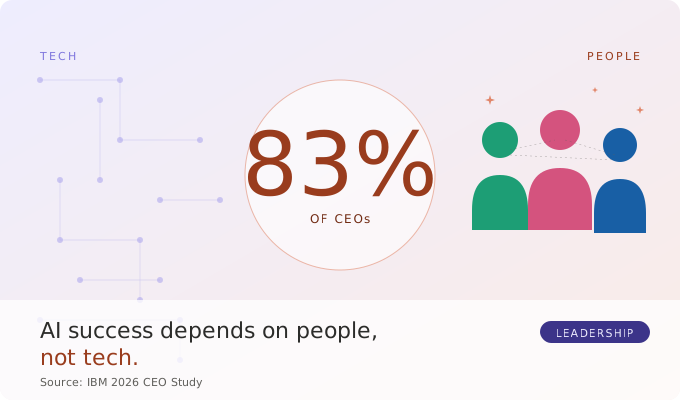
Most AI transformation efforts stall before they reach their potential. Not because the technology fails — but because the organizations running it underestimate what it takes to get people to actually change how they work. A new study from IBM makes this concrete: 83% of CEOs say AI success depends more on people’s adoption than on the technology itself. For engineering leaders, that number reframes the entire transformation conversation.
Quick Summary
- Why the IBM 2026 CEO Study reshapes what engineering leaders need to prioritize right now
- The gap between AI adoption rates and actual workforce usage — and what it signals
- What role evolution looks like in real engineering teams that have made the transition
- Why the human component of AI transformation is harder to solve than the technical one
- What a structured adoption plan looks like based on projects CodeBranch has run in production
The C-Suite Is Reorganizing Around AI — and Engineering Is at the Center of It
The pressure on engineering leaders in 2026 is not coming from the technology. It’s coming from above.
The IBM 2026 CEO Study — which surveyed 2,000 CEOs across 33 countries between February and April 2026 — shows that organizations are redesigning leadership structures specifically around AI. The number with a Chief AI Officer jumped from 26% in 2025 to 76% in 2026. That is not a gradual shift. That is an organizational decision being made simultaneously across industries.
The implication for engineering leaders is direct. 85% of respondents say all functional leaders must become technology experts in their domain. AI accountability is no longer concentrated in a specialized role — it is distributed across every function. For Engineering Directors and CTOs, this means the expectation has changed: they are now accountable not just for building with AI, but for demonstrating that their teams actually use it.
That accountability gap — between having AI tools and showing measurable results from them — is where most engineering transformations stall.
Why Does AI Adoption Stall in Engineering Teams?
The IBM study surfaces a number that explains a great deal of organizational frustration: only 25% of the workforce uses AI regularly as part of their job, even though 86% of CEOs believe their employees have the skills to collaborate with AI.
That 61-point gap is not a technology problem. The tools exist. The infrastructure is often in place. The gap is a human one — and engineering teams are not exempt from it.
At CodeBranch, we have seen this pattern from the inside. When we ran the agentic transformation of a six-person development team building a medical AI assistant for emergency rooms (see case study), the pipeline worked from week one. The agents were generating code. The CI/CD system was auditing outputs automatically. The technical infrastructure was functioning exactly as designed.
The team took three more weeks to trust it.
Senior developers — engineers with real technical depth — felt that stepping away from writing code diminished their professional value. That is not resistance to technology. That is a legitimate identity challenge: their expertise had been measured in code quality for years, and the new workflow asked them to stop writing and start orchestrating. Those are different skills, different feedback loops, and different ways of knowing whether you did good work.
The IBM study names this dynamic clearly. “AI success depends more on people’s adoption than technology,” 83% of CEOs confirmed. The organizations that have seen results are not the ones with the most sophisticated AI stack — they are the ones that invested in helping their teams understand what good work looks like in an AI-native workflow.
What Role Evolution Actually Looks Like in Production
Role evolution in AI-transformed teams is concrete, not abstract. In the healthcare project referenced above, three roles changed in specific and measurable ways.
Developers stopped working in IDEs and reviewing code line by line. Their function shifted to agent orchestration: writing precise prompts, validating that agent output meets acceptance criteria, and maintaining architectural standards. The pipeline handles automated quality checks. The developer handles judgment calls.
Designers stopped producing static Figma deliverables. They began guiding agents to build functional frontend prototypes directly in code — prototypes that stakeholders could interact with from day one. The feedback loop between client input and a working interface compressed dramatically.
QA Analysts moved from reactive manual testing to defining the test frameworks and validation rules that agents execute autonomously. Human review shifted to what automated testing cannot catch: nuanced functional behavior and domain-specific edge cases.
| Metric | Baseline | Agentic Pipeline | Change |
|---|---|---|---|
| Tasks per sprint | 45 | 225+ | 5x |
| QA rejection rate | Baseline | -85% | High precision |
| Design velocity | Baseline | 4x | High agility |
The IBM study’s finding that organizations with an AI-first C-suite design have scaled 10% more AI initiatives enterprise-wide than their peers is consistent with what we observe at the team level: structure and clarity about roles is what converts AI tools into AI results.
In a parallel project — a what-if scenario platform built for a semiconductor company managing supply chain decisions (see case study) — the human adoption challenge appeared differently. The technical output was sophisticated: an AI agent processing hundreds of variables and delivering scenario analysis in natural language. The adoption challenge was not with the engineering team. It was with the planners and decision-makers who needed to trust AI-generated insights for operational decisions. Making complex data accessible to non-technical users is also a people problem — one that requires deliberate design choices, not just functional code.
Definition: An agentic development pipeline is a system where AI agents operate concurrently across the development stack — generating, auditing, and validating outputs at each stage — while human team members shift from execution to orchestration, judgment, and quality architecture. The technology enables the speed. The people determine whether that speed holds.
What Does a Structured AI Adoption Plan for Engineering Teams Look Like?
The IBM study identifies a specific pattern among organizations that have delivered on AI objectives: those that redesigned five core business areas — technology, finance, HR, operations, and cross-functional collaboration — are four times more likely to have delivered on business objectives than those that didn’t. The common thread is not the sophistication of the AI stack. It is the deliberateness of the change management around it.
In the engineering context, that deliberateness shows up in three practices that CodeBranch applied directly in the healthcare transformation — and that determine whether an AI adoption holds or collapses within the first sprint.
Individual coaching from day one, not as a correction. The initial training in the healthcare project was a group kickoff session covering the methodology, the tools, and the rationale. It was not enough. Within the first sprint, it became clear that each team member had a different relationship with the transition. One-to-one pair sessions became the actual adoption mechanism: pair programming with developers, pair design with the designer, pair QA with the analyst. They should have been part of the plan from the start, not a response to friction that had already developed.
Daily follow-up as a structural requirement, not a management preference. The correlation between daily team check-ins and output was direct and measurable. In a traditional workflow, a weekly sprint review catches most problems before they compound. In an agentic workflow — where velocity is high and the team is navigating a new operating model — a problem that goes three days without identification can consume a full sprint’s output. Daily follow-up is the feedback mechanism the methodology requires.
A human authority protocol that protects both quality and identity. No agent output was integrated without senior architectural sign-off. This addressed the quality concern and the identity concern simultaneously — humans remained the final decision-makers, and the pipeline made their decisions more informed. The metric shifted from “lines of code written” to “system quality maintained and agent output validated.” Engineering value did not disappear. It moved upstream.
From the IBM 2026 CEO Study: Between 2026 and 2028, organizations expect 29% of employees to require reskilling for a different role and 53% to need upskilling to perform their current role more effectively. For engineering teams already working with AI pipelines, that reskilling is not a future event — it is happening now, sprint by sprint.
What the Rise of the CAIO Means for How Engineering Works With Leadership
When a CAIO exists in the C-suite, engineering leaders are no longer the only technical voice in the conversation about AI strategy. They gain an ally — but also a new accountability structure. The question shifts from “is engineering using AI?” to “what governance framework does engineering have in place?”
The IBM study’s finding on governance underscores this: 83% of executives say AI sovereignty is essential to business strategy. By 2030, surveyed CEOs expect 48% of operational decisions where consistency and guardrails can be codified will be made by AI without human intervention, compared to 25% today.
For engineering teams, this has a concrete implication: the pipeline they build today is the governance infrastructure their organization will depend on in four years. A pipeline without guardrails, without quality gates designed for AI output, without clear human authority protocols is not just a technical liability — it is a strategic one.
This connects directly to what the article Using AI Tools Is Not the Same as Having an AI Process documents: without measurement, AI adoption is invisible to leadership. With metrics — cycle time, defect rate, deployment frequency, QA rejection rate — it becomes a competitive advantage that engineering can quantify and defend in a boardroom conversation.
Five Takeaways From the IBM 2026 CEO Study for Engineering Leaders
-
The CAIO signal is real and immediate. 76% of organizations globally now have a Chief AI Officer. Engineering leaders not already in active conversation with their C-suite about AI accountability and governance are operating behind the curve.
-
The adoption gap is a structure problem, not a skills problem. Engineering teams that operate without shared standards for how AI is used produce inconsistent results — regardless of individual skill level. The fix is not more training. It is a defined framework for how AI tools interact with the codebase, the backlog, and the review process.
-
Role redefinition is where velocity becomes sustainable. At 5x delivery speed, the bottleneck moves from execution to judgment — what to build, how to validate it, when to override an agent’s output. Teams that redefine roles explicitly hold that velocity over time. Teams that don’t revert to old patterns within weeks.
-
Governance is engineering’s next competitive advantage. By 2030, CEOs expect 48% of operational decisions to be made by AI without human intervention. The engineering team that builds guardrails today — quality gates, agent rules, human authority protocols — is building the infrastructure that leadership will rely on for a decade.
-
Measurement is what makes AI investment defensible — and repeatable. Organizations that redesigned five core business areas are four times more likely to have delivered on AI objectives. For engineering, that starts with four numbers tracked from the first sprint: tasks completed, QA rejection rate, design iteration speed, and pipeline utilization. Without them, AI transformation is a story. With them, it is an asset.
Is your team ready to make the shift from AI tools to AI results? The AI Readiness Assessment gives you a complete picture of where your pipeline and team stand today, and a prioritized roadmap to close the gaps.
Not sure where to start? The AI-Ready Gap Analysis gives you a concrete audit of your development pipeline, a prioritized transformation roadmap, and ROI projections — in one to three weeks, at a fixed fee, with no obligation to continue.
Written by the CodeBranch team.
CodeBranch is an agentic software development boutique based in Medellín, Colombia. We specialize in building AI-optimized development pipelines for product teams in the United States.
Frequently Asked Questions
What is the difference between AI adoption and AI transformation?
How long does it take for an engineering team to operate effectively in an AI-native workflow?
What is a Chief AI Officer and why does it matter for engineering teams?
Is CodeBranch a good fit for companies that need to transform an existing engineering team?
How does CodeBranch measure whether an AI transformation is working?
CodeBranch Team
CodeBranch is an agentic software development boutique based in Medellín, Colombia, with 20+ years of experience building production software for US clients in healthcare, supply chain, fintech, proptech, and connected devices.
Related Articles
AI for Healthcare: What's New and What Founders Can Actually Build Today
AI for healthcare is moving from experiments to production. See what's new, what works, and what CodeBranch can build for healthtech founders today.
From 45 to 225+ Tasks per Sprint: How an Agentic Development Pipeline Transformed a Medical AI Project
How CodeBranch achieved 5x development speed and 85% fewer QA rejections building a medical AI assistant for emergency rooms using agentic pipelines.