
Agentic vs. Traditional Development: What Changes, and When to Switch
CodeBranch Team
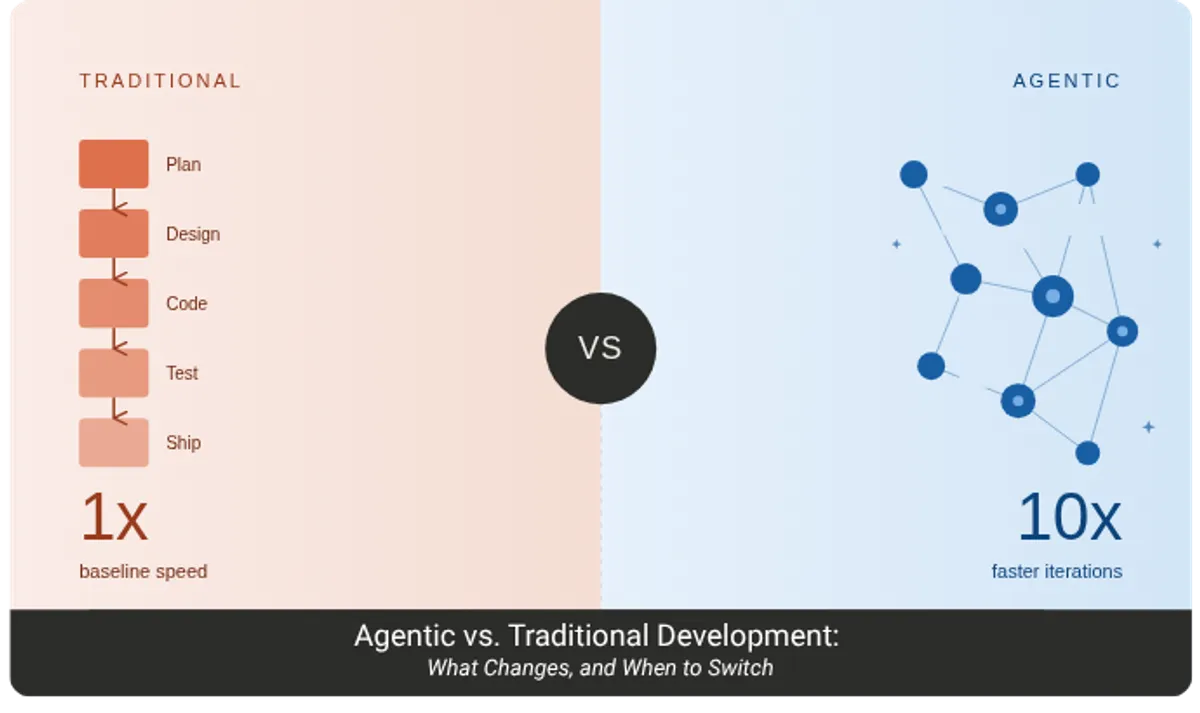
Most engineering teams using AI are shipping the same volume they were two years ago. The tools changed. The process didn’t. A code assistant here, a test generator there — but the delivery metrics haven’t moved. That gap between using AI tools and building with an AI-native process is exactly what agentic software development addresses, and the difference in results is measurable.
What Is Agentic Software Development?
Agentic software development is a methodology where AI coding agents, automated CI/CD pipelines, and a Spec-Driven Development framework operate alongside human developers to deliver production-ready software faster, with fewer defects, and at lower total cost than traditional development teams.
In a traditional development pipeline, work moves sequentially. A designer produces static mockups. A developer writes code manually against those specs. A QA analyst runs regression tests after the fact. At each handoff, lag accumulates — and errors surface only at the end of the cycle.
An agentic pipeline replaces that sequence with concurrent execution. AI agents handle the execution layer: writing boilerplate code, running automated tests, validating commits, auditing output against architectural standards, and generating documentation. Human developers shift their focus to architecture, system design, and the decisions that require contextual judgment. Quality is embedded at every stage rather than checked at the end.
At CodeBranch, this methodology runs on three components:
SDD Framework (Spec-Driven Development) — every feature is fully specified before any agent touches it. This eliminates the ambiguous requirements that generate rework at high velocity.
Agentic CI/CD pipeline — includes agent rules that define how AI tools interact with the codebase, automated quality gates that catch AI-specific failure patterns before human review, and monitoring that tracks delivery metrics over time.
Structured coaching program — ensures the team operates confidently in new roles. The technical infrastructure alone doesn’t produce results if the people running it don’t trust it.
The 2025 DORA Report confirms what we observe in practice: AI amplifies what already exists in the system. Teams with mature processes and clear standards see compounding gains. Teams without them find that AI only accelerates existing problems. The methodology is the multiplier.
How Does Agentic Development Compare to Traditional Development?
The comparison is most useful when it’s concrete — not a list of adjectives, but measurable dimensions that engineering leaders can evaluate against their current state.
| Dimension | Agentic Development | Traditional Development |
|---|---|---|
| Development speed | 5x faster — AI agents handle repetitive tasks | Linear — human capacity is the ceiling |
| Code review | Automated + AI-assisted at every commit | Manual pull requests, often delayed |
| Spec discipline | Enforced via SDD Framework before every feature | Often skipped under deadline pressure |
| QA integration | Baked into CI/CD pipeline from day one | Separate QA phase at the end |
| Scalability | Add AI capacity without adding headcount | Scale = hire more developers |
| Cost efficiency | AI handles repetitive work; humans focus on architecture | All tasks at human hourly rates |
| Predictability | Fixed-price milestones with AI-validated outputs | Estimates shift as scope evolves |
| Knowledge transfer | Agent rules + specs document decisions automatically | Tribal knowledge stays in people’s heads |
The numbers in the table come from production. In a healthcare AI project, the same six-person team went from 45 to 225+ tasks per sprint in six weeks. The bottleneck that nearly reversed those gains wasn’t the pipeline — it was backlog quality. At 5x velocity, a vague requirement doesn’t slow the team. It stops it.
The Stack Overflow 2025 Developer Survey puts the frustration with the alternative in concrete terms: 66% of developers cite AI solutions that are “almost right, but not quite” as their biggest frustration. That’s not a product of bad tools. It’s a product of tools operating without a structured pipeline around them. Agentic development is the structure.
What Changes for the Engineering Team
In an agentic pipeline, humans and agents operate concurrently — agents execute, humans decide. That structural shift changes what each role does day to day.
Developers move from writing to reviewing. The pipeline generates the code; the developer evaluates whether it meets the standard — architecturally, functionally, and against the acceptance criteria. The measure of good work shifts from output volume to judgment quality.
Designers stop producing static Figma deliverables and start guiding agents to build functional frontend prototypes directly in code. Stakeholders interact with something working from day one. The feedback loop between client input and a usable interface compresses from weeks to days.
QA Analysts move from running tests to designing the frameworks that agents execute autonomously. Human review focuses on what automated testing can’t catch: nuanced functional behavior, domain-specific edge cases, and outputs that require understanding the product’s intent — not just its specs.
Sprint capacity expands without a proportional increase in cognitive load, because agents handle parallel execution while developers maintain architectural oversight across multiple requirements simultaneously.
When Does Agentic Development Make Sense — and When Doesn’t It?
Agentic development is not the right methodology for every project.
It makes sense when:
- The team has a backlog larger than its current capacity. Agentic pipelines expand delivery capacity without adding headcount. If the constraint is “we can’t ship fast enough with the people we have,” agentic development addresses that directly.
- The project has high repetitive implementation alongside complex architecture. Agents handle boilerplate generation, test writing, documentation, and commit validation. Projects with a high ratio of execution to reasoning benefit most.
- The team is ready to adopt shared standards. The SDD Framework requires every feature fully specified before any agent touches it. Teams that invest in backlog precision see compounding gains. Teams that don’t produce inconsistent output faster.
- The organization needs measurable ROI on AI investment. Agentic development produces the metrics that make AI transformation legible to leadership: cycle time, defect rate, deployment frequency, and QA rejection rate from sprint one.
- The project is in a regulated or compliance-sensitive industry. Compliance requirements can be codified into agent rules and quality gates — enforced at the pipeline level on every commit. CodeBranch has applied this in healthcare and supply chain.
It is not the right fit when:
- The project scope is very small and short. The setup cost of configuring agent rules, CI/CD integration, and the SDD Framework is front-loaded. For a two-week fixed-scope project with no follow-on work, that investment doesn’t pay back within the engagement.
- The team has no shared technical standards. Agentic pipelines amplify what already exists in the system — including inconsistency. A team without agreed architectural patterns will produce faster inconsistency, not faster quality.
- The requirements are genuinely undefined. Agents produce output based on what they receive. If the product vision isn’t clear enough to specify features concretely, the right first step is a Product Definition phase — not an agentic sprint.
CodeBranch runs an AI-Ready Gap Analysis for exactly this reason: to assess where a team and codebase actually stand before recommending an engagement model. The output is a prioritized roadmap and ROI projections — not a recommendation for a transformation that may not be the right move yet.
How CodeBranch Implements Agentic Development
CodeBranch is an agentic software development boutique based in Medellín, Colombia, specializing in AI-optimized development pipelines for product teams in the United States. Most AI engagements address the tooling. We address three things simultaneously — the technical pipeline, the SDD methodology, and the human adoption system — because the tooling alone doesn’t hold.
Every CodeBranch engagement follows one of three models:
Product Definition & Scoping — translates a product vision into a fully specified, agent-ready backlog. Fixed scope, weekly retainer, 1-4 weeks. The output can drive an agentic sprint with any team.
Scope-Based Development — fixed price, milestone-driven delivery, agentic CI/CD pipeline configured from day one with the SDD Framework. Every feature specified before any agent touches it.
Dedicated Agentic Team — monthly retainer, flexible team size, US time zones. No long-term contracts. The client owns 100% of the codebase, pipeline configuration, agent rules, and all IP.
The supply chain project — a what-if scenario platform for a semiconductor company managing hundreds of variables across demand, risk, and operational constraints — was built under the Dedicated Team model. It is an example of what agentic development produces when the methodology, the pipeline, and the team are aligned from day one.
Ready to evaluate whether agentic development is the right fit for your team? Start a conversation or take the AI Readiness Assessment.
Frequently Asked Questions
What is the difference between agentic and traditional software development?
How much faster is agentic development compared to traditional teams?
Does agentic development work for regulated or compliance-sensitive industries?
Is CodeBranch a good fit for teams that want to adopt agentic development without rebuilding from scratch?
What does a CodeBranch agentic development engagement look like in practice?
CodeBranch Team
CodeBranch is an agentic software development partner for U.S. companies, from building new products to scaling existing ones — senior-led teams in Colombia, working U.S. hours. We deliver with AI-native pipelines and our own Spec-Driven Development framework, with quality and security built into every line of code.