Quick Summary
- ▸ CodeBranch led the transformation of a development team to an AI agent-driven methodology for an emergency room medical assistant application, achieving a 5x increase in development speed and an 85% reduction in QA rejections within six weeks.
- Achieved a 5x increase in development velocity — from 45 to 225+ tasks per sprint.
- Achieved a 4x increase in design velocity through functional prototyping with AI agents.
Overview
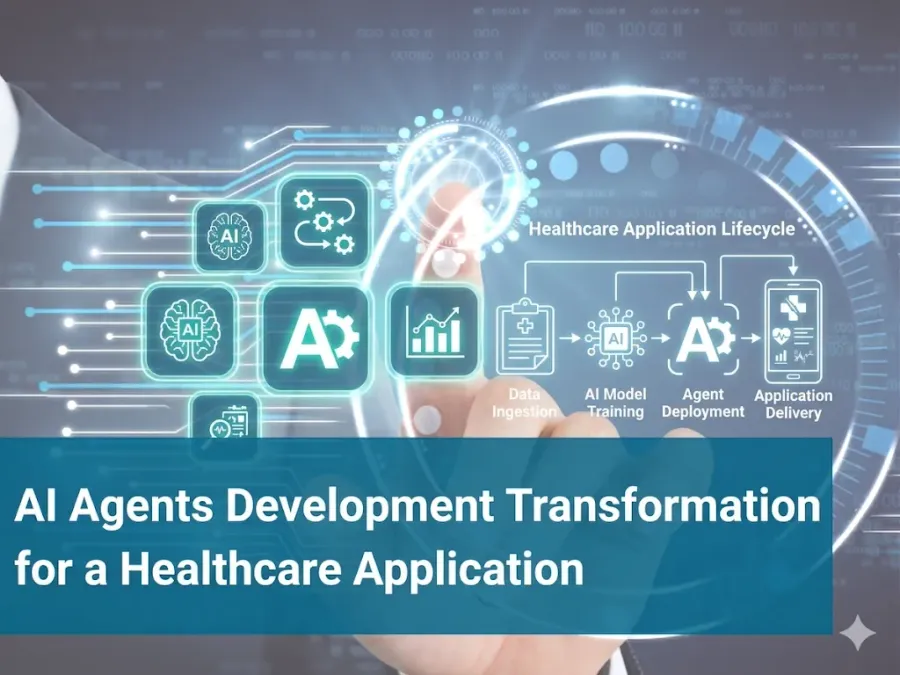
This case study documents the transformation of a six-person development team from a traditional AI-assisted workflow to a fully agent-driven development methodology. The project — an intelligent medical assistant for emergency rooms designed to support physicians when specialists are not yet available — served as the proving ground for a new approach where developers, designers, and QA analysts shifted their roles from hands-on execution to guiding, orchestrating, and auditing AI agents. The transformation was executed in four phases over six weeks, covering project management tooling, development pipeline automation, design integration, and QA automation. Results exceeded the initial 2x–3x acceleration hypothesis, reaching 5x in development velocity and 4x in design velocity, while reducing QA rejections by 85%.
Industries
Services Provided
- AI-Driven Development Methodology
- Development Pipeline Automation
- Team Transformation & Coaching
- AI Agent Integration
- Quality Assurance Automation
- Custom Software Development
Approach
The transformation followed a structured four-phase rollout. First, the project was migrated to a proprietary project management platform with integrated performance tracking, prompt engineering support, and assisted estimation. Second, the development pipeline was rebuilt as a closed-loop system where AI agents (Claude by Anthropic and Codex by OpenAI) generate code that is automatically audited for quality, codebase alignment, and architectural compliance. Third, the design process was embedded into the agent methodology, allowing the designer to produce functional frontend prototypes that are handed off to developers for backend integration. Fourth, end-to-end testing and AI-assisted QA were added to the pipeline. Training included a group kickoff session followed by personalized 1-on-1 pair sessions (pair programming, pair design, pair QA) to ensure effective adoption. Continuous daily follow-up and personalized coaching addressed both technical and emotional challenges of the role transformation.
Results
- Achieved a 5x increase in development velocity — from 45 to 225+ tasks per sprint.
- Achieved a 4x increase in design velocity through functional prototyping with AI agents.
- Reduced QA rejections by 85% through automated auditing and closed-loop pipelines.
- Enabled the team to work on multiple requirements in parallel instead of sequentially.
- Exceeded the initial hypothesis of 2x–3x acceleration within six weeks of implementation.
- Improved team autonomy, product ownership, and proactive contribution to the product roadmap.