
AI Agents: Transforming Software Development
CodeBranch Team
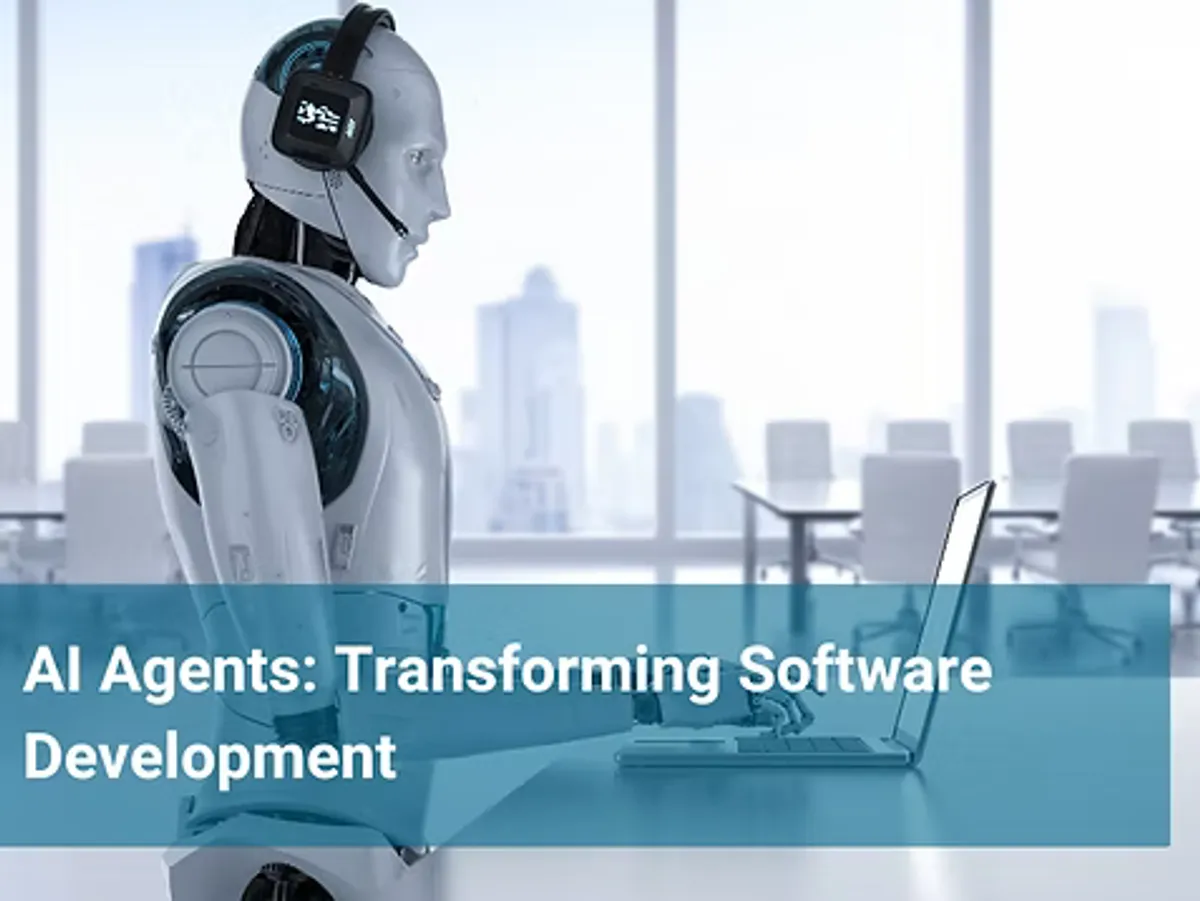
An AI agent is a software program designed to autonomously perform tasks on behalf of a user or another system. These agents interpret their environment, make decisions based on perceived data, and execute actions to achieve specific goals with minimal or no human intervention. In software development, they are changing how code is written, tested, and deployed.
Quick Summary
- AI agents autonomously perform tasks by interpreting their environment, making decisions, and learning from experience
- Seven classification levels range from simple reflex agents to multi-agent systems that collaborate on complex problems
- Enterprise adoption reached 51% in 2024, with 78% of organizations planning implementation
- CodeBranch uses AI agents in its agentic development pipeline to deliver 5x faster while senior engineers focus on domain decisions
What Are AI Agents and How Do They Work?
AI agents use advanced algorithms, including machine learning and natural language processing, to handle a wide range of tasks — from answering simple inquiries to resolving complex, multi-step problems. They adapt to new information in real time, plan sequences of actions, and learn from their experiences to improve performance over time.
In practical applications, AI agents are employed across domains: customer service (understanding and responding to queries without human intervention), software development (generating and testing code), personal assistance (scheduling and task management), and industrial automation (monitoring and optimizing processes).
How Are AI Agents Integrated into Development Processes?
Integrating AI agents into development workflows involves several key steps:
-
Development tools and platforms — Use platforms that offer toolkits for building AI agents. IBM’s watsonx.ai Agent Builder, for example, provides a low-code interface for designing and deploying agentic services.
-
Team composition — Assemble a multidisciplinary team: machine learning engineers, data scientists, software developers, and UI/UX designers. This ensures the AI agent is robust, user-friendly, and integrated with existing systems.
-
Integration with existing systems — Develop custom APIs or middleware to facilitate communication between the AI agent and other software components. Seamless integration with current tools and workflows is critical.
-
Data integration and management — Connect AI agents with existing data sources. Data integration remains a major hurdle — a significant number of IT leaders identify it as the primary challenge in AI agent adoption.
-
Testing and validation — Validate decision-making processes, assess interactions within the system, and verify performance against predefined metrics.
-
Continuous monitoring and improvement — After deployment, collect user feedback and system data to identify areas for improvement, allowing the agent to evolve with changing requirements.
How Are AI Agents Classified?
AI agents are classified into seven types based on complexity and functionality:
-
Simple reflex agents — Act solely on current input using condition-action rules, without considering history or context.
-
Model-based reflex agents — Maintain an internal model of the world, handling partially observable environments by tracking aspects that are not immediately visible.
-
Goal-based agents — Consider future actions and the desirability of outcomes, making decisions aligned with specific objectives.
-
Utility-based agents — Assess possible actions and select the one that maximizes a utility function, handling trade-offs and uncertainties.
-
Learning agents — Learn from experience and improve over time through components like a learning element, performance element, critic, and problem generator.
-
Hierarchical agents — Operate at multiple levels of abstraction, breaking complex tasks into manageable subtasks.
-
Multi-agent systems (MAS) — Multiple agents interact within an environment, collaborating or competing to achieve individual or collective goals.
What Are the Real-World Applications of AI Agents?
-
Customer support — AI-powered chatbots like Ada automate customer service by understanding natural language queries, scheduling appointments, and processing payments.
-
Autonomous vehicles — AI agents analyze sensor data to navigate roads, detect obstacles, and make real-time driving decisions.
-
Personal assistants — Amazon Alexa and Apple Siri process voice commands, manage tasks, and control smart home devices.
-
Healthcare diagnosis — AI agents assist healthcare professionals by analyzing patient data to provide diagnostic suggestions and recommend personalized treatments.
-
Fraud detection — Financial institutions use AI agents to analyze transaction data, identify anomalies, and prevent fraudulent activities.
Where Does AI Agent Adoption Stand Across Industries?
The adoption of AI agents is accelerating across sectors. Here are the key data points:
| Sector / Category | AI Adoption |
|---|---|
| Enterprises using AI agents | 51% |
| Mid-sized companies | 63% |
| Companies planning to use AI agents | 78% |
| Global AI adoption (2024) | 72% |
| Consumers comfortable with AI purchases | 24% |
| Consumers comfortable with AI scheduling | 39% |
| Healthcare AI adoption (2021) | 20% |
| Projected hospital AI use (2025) | 90% |
| Financial services AI implementation | 59% |
| Insurers viewing AI as strategic priority | 90% |
What Comes Next for AI Agents?
AI agents will become more autonomous, collaborate more effectively through multi-agent architectures, and integrate more deeply into daily business operations. Advances in multimodal AI will enable smarter, context-aware interactions across text, voice, and visual inputs.
The challenges — data privacy, ethical considerations, integration complexity — remain real. But the trajectory is clear: organizations that adopt AI agents early and integrate them into their core workflows gain a compounding advantage in productivity, speed, and decision quality.
Frequently Asked Questions
What is an AI agent in software development?
How does CodeBranch use AI agents in its development process?
What types of AI agents exist?
What industries are adopting AI agents fastest?
Can CodeBranch build custom AI agents for my company?
CodeBranch Team
CodeBranch is an agentic software development partner for U.S. companies, from building new products to scaling existing ones — senior-led teams in Colombia, working U.S. hours. We deliver with AI-native pipelines and our own Spec-Driven Development framework, with quality and security built into every line of code.